15 Real Estate Ads Examples That Actually Convert (Plus the Strategies Behind Them)
Real estate ads are one of the fastest ways to get a listing in front of the right buyers, but most agents are still relying on the same tired templates that blend into the noise. In this guide, we break down 15 winning ad examples and the strategies behind them, so you can create campaigns that actually convert.
Nathan SmithPublished Dec 15, 2025Updated Jul 14, 202615 min read
What is the best way to advertise in real estate?
Here's what I've discovered after auditing hundreds of real estate ad campaigns: the agents who consistently generate quality leads aren't relying on a single advertising channel. They're orchestrating coordinated campaigns across multiple platforms.
While most agents are still posting listings on social media and hoping for the best, successful real estate professionals are building integrated marketing systems. They're combining paid social ads with Google search campaigns, retargeting previous website visitors, and running targeted display ads to homeowners in specific neighborhoods.
The truth about multi-channel marketing in real estate
Your advertising approach should mirror how your ideal clients actually search for properties. First-time homebuyers behave differently than luxury property investors. Young families prioritize different channels than retirees looking to downsize.
Start by identifying where your target market spends their time online. Compare organic and paid channels to determine the best fit, then allocate your budget proportionally.
In my conversations with top-producing teams, most dedicate 40-50% of their ad spend to social platforms, 30-40% to search advertising, and the remainder to retargeting and display campaigns.
Your business goals matter too. If you need immediate buyer leads, search ads deliver faster results. Building long-term brand recognition? Social media and content marketing require more patience but create lasting value.
Do leads actually convert from real estate ads?
Real estate ad leads convert at wildly different rates depending on how you run your campaigns.
Here's what the data actually shows.
Cold leads from general awareness campaigns typically convert at 1-3%.
Better-targeted ads focused on specific buyer personas push that to 5-8%.
The best performers which include detailed audience segmentation and well designed copy see conversion rates of 12-15% or higher.
Your ROI from real estate ads isn't determined by the ad itself. It's determined by your entire system, from targeting to landing page to how well you qualify a real estate lead once they reach out.
What is the best channel for ad distribution?
There's no single "best" advertising channel in real estate, only channels best suited for specific objectives.
That said, digital platforms have fundamentally transformed how buyers search for properties and are one of the strongest ways to generate leads.
Digital channels meet buyers where they already are, offer precise targeting that traditional media can't match, and provide real-time performance data that lets you optimize campaigns on the fly.
While traditional media still serves specific purposes, the shift in consumer behavior toward digital consumption makes online channels one of the most efficient marketing methods.
15 Effective real estate ad examples
These examples are gathered from Meta's Ads Library across Facebook and Instagram, which provides transparency into active and inactive ads running on these platforms.
The Meta Ads Library is an excellent free resource for discovering what competitors are running, analyzing th eir messaging strategies, and identifying successful ad formats in your market.
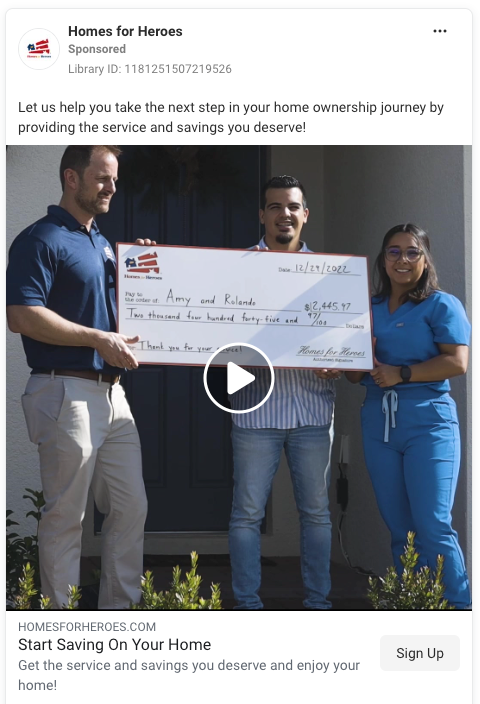
Lead Magnet Ad Offering Free Buyer Consultation
Lead magnets work by offering valuable resources in exchange for contact information, capturing prospects before they're ready to commit to working with an agent. This approach builds your pipeline with future clients who will remember you provided value when they're ready to buy or sell.
Why this ad is effective:
Removes commitment barriers by offering consultation instead of demanding immediate property viewings
Casual video format in authentic outdoor setting builds approachability and relatability
Captures early-stage prospects during research phase before competitors reach them
Creates permission for future follow-up without feeling pushy or aggressive
Multiple Cash Offer Guarantee for Sellers
Guarantee-based ads overcome seller hesitation by eliminating their biggest fear: uncertainty about whether their home will sell.
Why this ad is effective:
Bold red background design cuts through feed clutter instantly
Addresses primary seller anxiety about sale certainty and pricing
Multiple offer guarantee creates competitive tension favoring the seller
Comparative Market Analysis Offer with Team Branding
Value-first ads that offer analytical tools or reports attract high-quality leads by demonstrating expertise before asking for business. Homeowners requesting market data are actively considering selling, making them far more valuable than cold prospects.
Why this ad is effective:
Market analysis offer provides genuine value while qualifying serious sellers
Reference to changing markets creates timely relevance without manufactured pressure
Clean design with visible contact information signals professional organization
Attracts data-driven homeowners in active decision-making mode
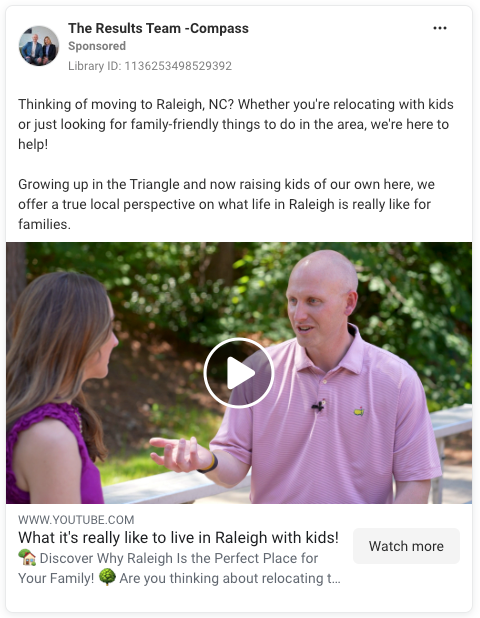
Video Interview Showcasing Local Lifestyle and Expertise
Lifestyle-focused ads sell the transformation and experience rather than property specifications, creating emotional connections that pure listing ads cannot achieve. This approach particularly resonates with relocation buyers who need insider knowledge about unfamiliar areas.
Why this ad is effective:
Features real local residents discussing experiences builds trust faster than agent claims
Positions agent as insider expert and community connector
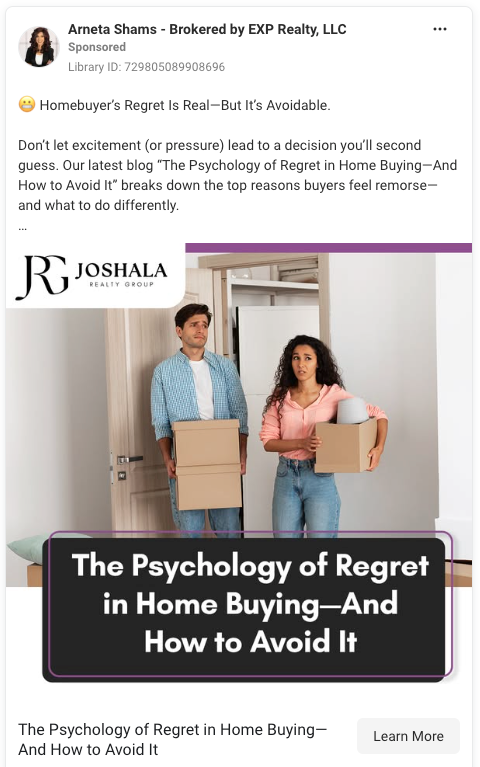
Educational Blog Content Addressing Buyer Concerns
Educational content marketing establishes agents as trusted advisors by addressing real concerns without immediate sales pressure.
Why this ad is effective:
Leading with common fear creates immediate emotional resonance
Positions agent as educator and problem-solver rather than salesperson
Relatable imagery of young homeowners creates emotional connection
Captures early-stage buyers who aren't ready for traditional agent contact
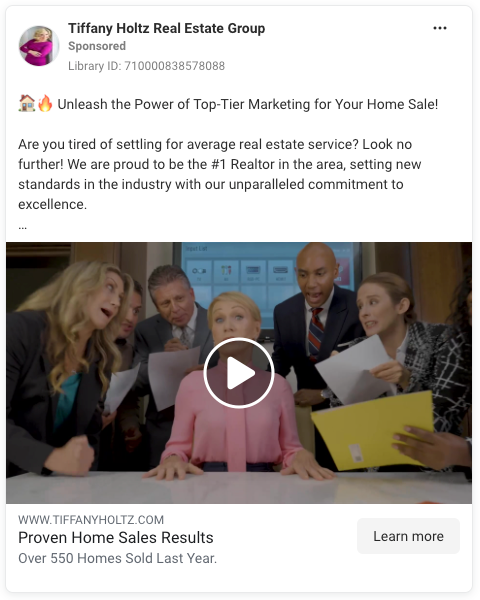
Social Proof Ad Highlighting Sales Volume and Results
Track record ads leverage past success to build confidence with future clients. Specific metrics about homes sold and results achieved are a strong differentiator in markets where everyone claims to be the best.
Why this ad is effective:
Specific metrics about 550+ homes sold provide concrete proof of experience
Promise of top-tier marketing addresses seller concerns about property exposure
Incorporation of celebrity endorsement
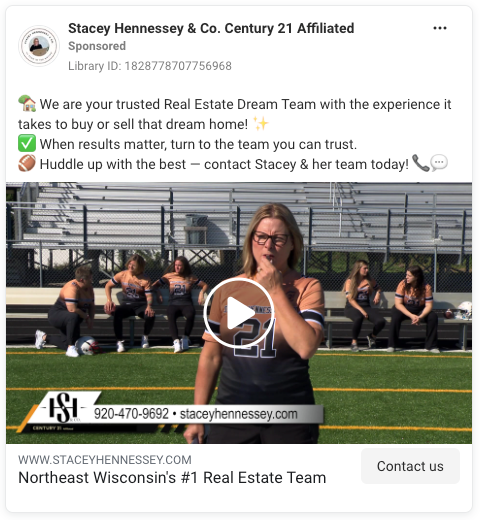
Personality-Driven Ad Using Humor and Local Expertise
Personality-based marketing creates memorability and differentiation in crowded markets. Younger demographics particularly value authenticity and approachability over formal corporate messaging when selecting service providers.
Why this ad is effective:
Casual tone with emojis creates memorability generic ads lack
Playful humor makes agent approachable and relatable
Emphasis on local knowledge positions team as insider experts
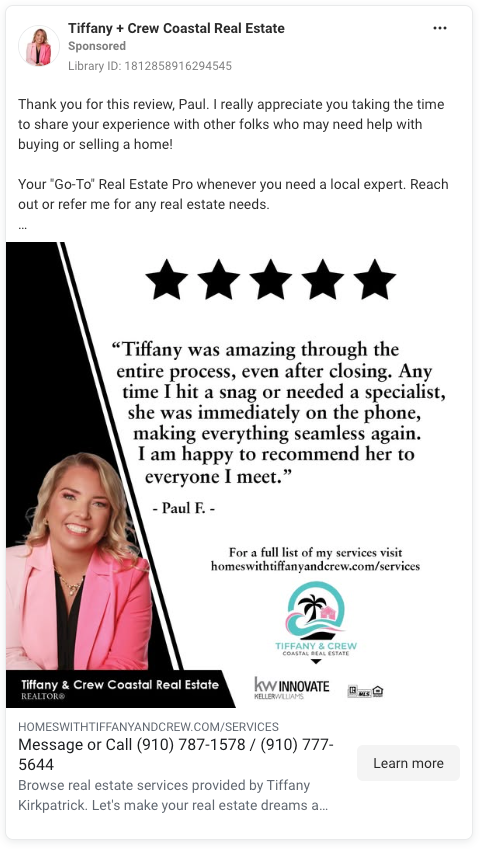
Five-Star Client Testimonial with Specific Results
Testimonial ads outperform agent self-promotion because satisfied client voices carry authentic credibility. Specific details about positive experiences address common buyer and seller concerns more convincingly than any marketing claim.
Why this ad is effective:
Visual five-star rating immediately signals quality and satisfaction
Detailed testimonial mentioning post-closing support addresses abandonment fears
Specific results and experiences feel authentic rather than manufactured
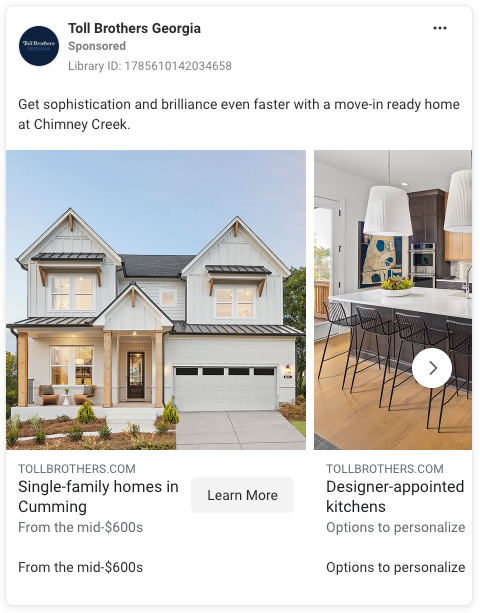
New Construction Carousel Featuring Multiple Home Options
Carousel ads maximize information delivery within limited ad space by allowing multiple images or properties in a single ad unit. This format works particularly well for showcasing either multiple listings or multiple features of a single property.
Why this ad is effective:
Carousel format efficiently showcases both exterior appeal and interior quality
Clear pricing range from mid-$600s immediately qualifies prospects
Professional photography reflects actual home quality and builds confidence
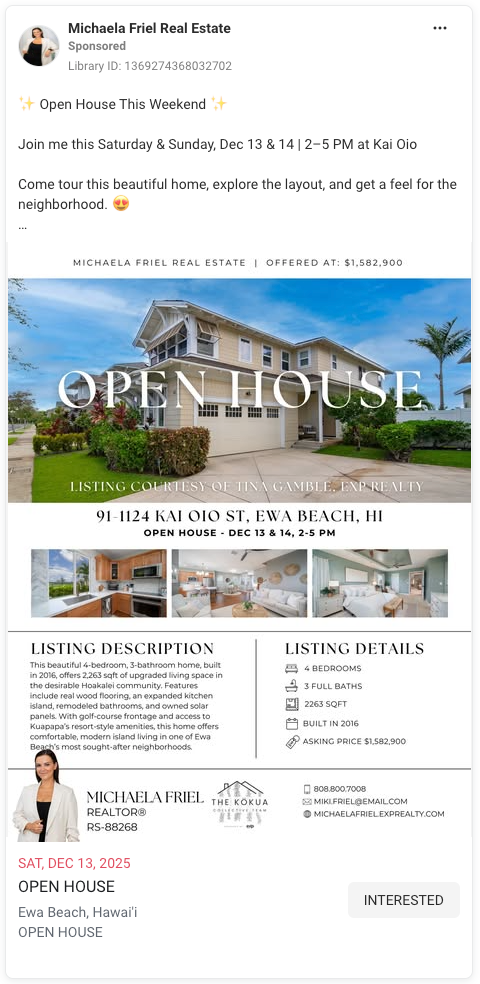
Time-Sensitive Open House Event Promotion
Event promotion ads create natural urgency through specific dates and times without artificial pressure tactics.
Why this ad is effective:
Specific dates and times create genuine urgency without manipulation
Comprehensive details including price, specs, and photos enable pre-qualification
Offers specific, low-commitment next step for interested prospects
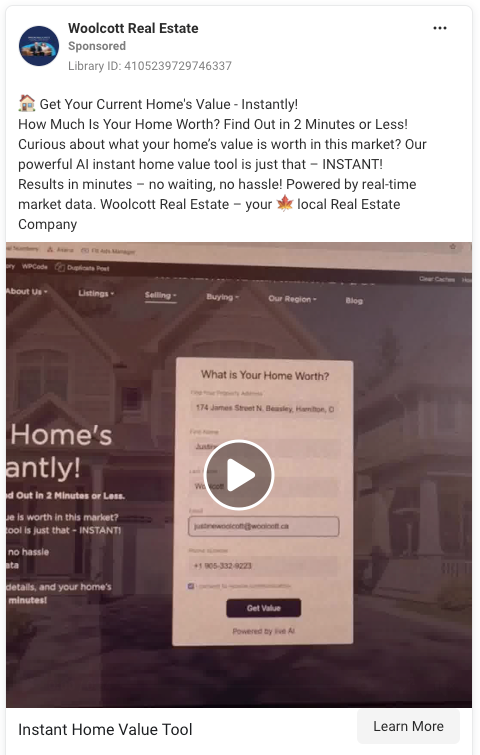
AI-Powered Home Valuation Tool for Instant Results
Interactive tool ads satisfy immediate curiosity while capturing contact information for follow-up. The promise of instant results removes time investment barriers that prevent engagement with traditional lengthy appraisal processes.
Why this ad is effective:
Instant gratification appeals to homeowner curiosity with minimal commitment
Emphasizes real-time data positioning as superior to slow traditional methods
Generates high lead volumes by satisfying curiosity while capturing contacts
Cause Marketing for Military and First Responders
Aligning services with meaningful causes attracts values-driven clients who become loyal advocates and generate referrals within their communities.
Why this ad is effective:
Connects services to military and first responder support creating emotional resonance
Attracts values-aligned clients who become loyal advocates
Creates self-sustaining referral network within specific communities
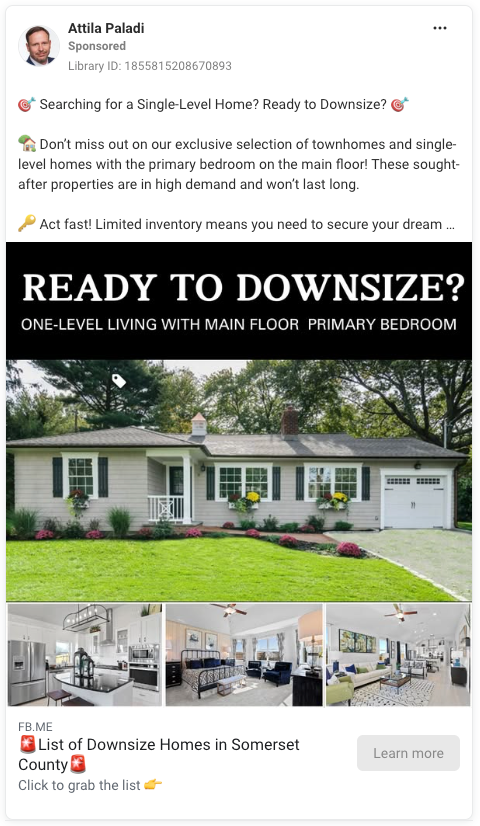
Downsizing Specialist Ad Addressing Senior Transition Concerns
Niche-focused ads targeting specific life transitions like downsizing resonate deeply because they address unique concerns that generic real estate ads ignore.
Why this ad is effective:
Directly addresses specific life stage transition instead of broad home buying/selling
Acknowledges emotional complexity of leaving long-time family homes
Positions agent as specialist understanding unique downsizing challenges
Similar niche-focused approaches that work:
First-time homebuyer specialists addressing financing anxiety and process confusion
Divorce real estate specialists handling sensitive asset division situations
Military relocation experts understanding PCS timelines and VA loan processes
Luxury downsizing for empty nesters wanting upscale condos with less maintenance
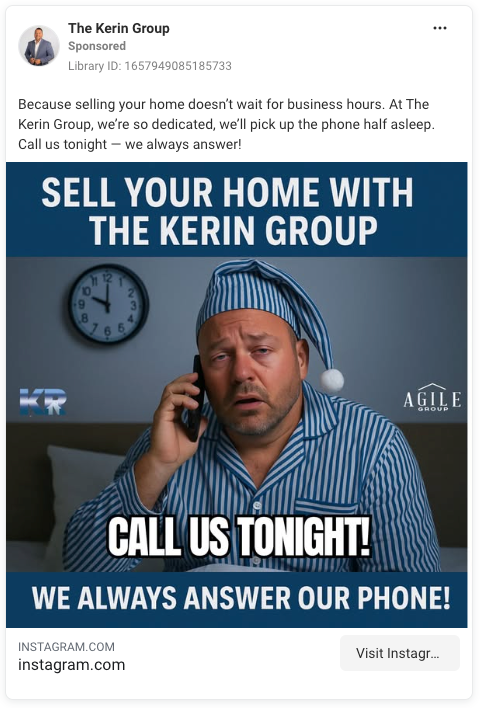
Meme-format ads leverage recognizable cultural references to grab attention and encourage social sharing.
Why this ad is effective:
Recognizable meme format immediately grabs attention and encourages sharing
Humorous approach makes genuine service differentiation memorable
Addresses specific pain point about agent unavailability
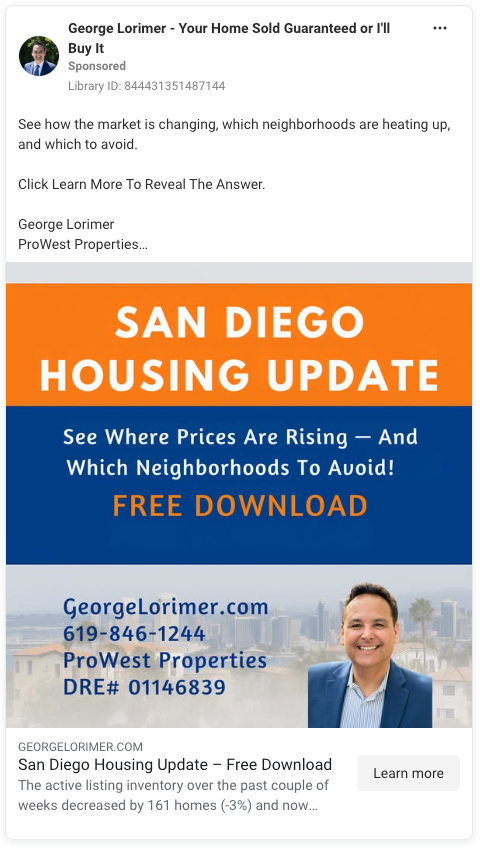
Geographic Market Intelligence Report for Download
Data-driven content establishes expertise and authority with analytical, research-oriented clients. Geographic specificity creates immediate relevance while actionable insights provide genuine value that builds trust before requesting business.
Why this ad is effective:
Specific neighborhood data about price trends provides actionable intelligence
Free download captures leads not ready for direct agent contact
Establishes expertise and authority with data-driven, analytical clients
How to create effective real estate ads
Throwing together an attractive photo and generic caption won't cut it anymore.
The agents generating consistent leads from advertising follow a systematic approach that starts well before they ever create an ad.
Identify Your Target Audience
Here's where most real estate ads fail before they even launch, they try to appeal to everyone.
Successful agents build detailed buyer personas before spending a dollar on advertising. They identify whether they're targeting first-time homebuyers in their late twenties saving for starter homes, growing families needing more space, empty nesters downsizing, or investors seeking rental properties.
Each persona requires completely different messaging.
First-time buyers care about affordability and financing options.
Growing families prioritize school districts and yard space.
Empty nesters want low maintenance and walkability.
Investors focus purely on rental income potential and appreciation forecasts.
Create 3-5 detailed personas representing your ideal clients. Then target high intent keywords for each one with tailored messaging that speaks directly to their specific motivations and concerns.
Highlight Key Property Features and Unique Selling Points
Every property has features.
Smart marketing focuses on the benefits those features deliver.
"Gourmet kitchen with professional-grade appliances" is a feature.
"Host holiday dinners where you'll actually enjoy cooking instead of feeling cramped and stressed" is the benefit that feature delivers.
Identify your top three unique selling points, the aspects that differentiate this property from others in its price range.
Recently renovated?
Extra lot space?
Income-generating ADU?
Assumable low-interest mortgage?
These become your hooks.
Then they prioritize ruthlessly. Your ad gets about three seconds to grab attention.
Lead with the single most compelling unique selling point that will resonate with your target buyer persona.
Craft Compelling Headlines and Descriptions
Your headline determines whether people keep scrolling or actually read your ad.
Generic headlines like "Beautiful Home in Great Neighborhood" generate yawns.
Specific headlines like "Waterfront Craftsman with Private Dock, 20 Minutes from Downtown" make people stop.
Use numbers whenever possible. "Newly Renovated Kitchen" is vague. "$80K in Recent Upgrades Including Chef's Kitchen and Spa Bath" creates tangible value.
The best headlines incorporate emotional triggers. "Stop Renting, Own This Condo for Less Than Your Current Rent" speaks directly to first-time buyers' frustrations. "Finally Have Space for Your Growing Family" resonates with parents in cramped starter homes.
Beautiful photos and videos grab attention, but social proof closes the deal.
Buyers scrolling through dozens of similar listings need reassurance that you deliver results.
High-quality visuals are the foundation. Professional property photos stop the scroll and invite closer inspection, while video content generates 4-6x more engagement than static images alone.
Listings that feature client testimonials or social proof elements see 35% higher inquiry rates than those relying solely on property features.
Incorporate these social proof elements directly into your visual content:
Five-star review ratings with the total number of reviews (e.g., "4.9 stars from 127 clients")
Specific testimonial quotes overlaid on property photos or featured in video intros
Video testimonials from actual clients discussing their experience (more authentic and engaging than written quotes)
"Recently sold" badges showing your track record in the neighborhood or price range
Client success metrics such as "Helped 50+ families find homes in 2024"
Before/after renovation photos with client testimonials about the transformation
Awards and recognition from local publications or industry organizations displayed as badges on ad creative
Include a Clear Call-to-Action
Ads without clear next steps waste money.
Your call-to-action should match where buyers are in their journey.
Early-stage researchers respond to "Download Free Buyer's Guide" or "View All Photos."
Mid-stage browsers want "Schedule Your Private Showing" or "Take Virtual Tour."
Late-stage buyers ready to make decisions respond to "Submit Your Offer" or "Attend Open House This Saturday."
Make your CTA button contrast visually from the rest of your ad.
Use action verbs. "Get Your Free Guide" outperforms "Learn More" because it's specific and value-focused.
Never leave people wondering what to do next. Every ad needs one clear, obvious action you want them to take.
How to prevent real estate ad fatigue
Ad fatigue occurs when your target audience sees the same ad so many times that they stop noticing or engaging with it—even if the content was initially compelling.
The problem isn't immediate.
Ad fatigue kills campaign performance gradually.
Your click-through rates decline.
Your cost per lead increases.
Complement ads with SEO to prevent paid dependency.
Eventually, you're paying premium prices for diminishing results because your creative has gone stale.
Rotate Ad Creatives Regularly
Plan creative rotations before launching campaigns, not after performance drops.
For campaigns running 4-6 weeks, plan at least three completely different creative variations.
Alternate between them weekly. This keeps your ads feeling fresh even to people who spend hours daily on social media.
Your first creative might feature exterior photos with lifestyle benefits in the copy.
The second highlights interior spaces with specific upgrade details.
The third uses video tours with testimonial quotes.
Monitor your frequency metrics closely. When individual users are seeing your ad more than three times per week, it's time to rotate to fresh creative.
Refresh Headlines and Descriptions
Your core message stays consistent, but how you communicate it should evolve.
Week one you might emphasize "Recently Reduced, Now $549K." Week two shifts to "Waterfront Living at an Unbeatable Price." Week three focuses on "Walk to Downtown Restaurants and Shops." Same property, same target audience, different angles that keep messaging fresh.
Test emotional versus rational appeals. Some headlines focus on lifestyle transformation while others emphasize practical value and savings. Different buyers respond to different messaging frames.
Small copy changes create perceived novelty. Switching from "Schedule your private showing" to "Book your exclusive tour" technically says the same thing but feels different to someone who's seen your previous ads.
Test Different Images and Videos
Visual variety prevents your ads from blending into the background.
Create a library of 8-12 high-quality photos for each listing. Rotate through different rooms, angles, and perspectives. Exterior shots from different times of day create different moods.
Alternate between photo ads and video content.
Video tours grab attention in feeds dominated by static images.
Then rotate back to photos to re-capture interest from people who've become blind to your video ads.
Segment Your Audience for Targeted Messaging
Showing identical ads to first-time homebuyers and luxury property investors guarantees mediocre results for both.
Create separate campaigns for each audience segment with messaging tailored specifically to their priorities.
Geographic segmentation matters too.
People searching within three miles of your listing are ready to tour now. Those 20+ miles away might be researching neighborhoods before they visit.
Different messages convert each group.
Limit Ad Frequency per User
Platform algorithms will happily show your ad to the same person forty times if you let them.
Set frequency caps in your campaign settings.
For awareness campaigns, limit exposure to 2-3 times per week per person. For conversion-focused campaigns targeting smaller audiences, you can push to 4-5 times weekly.
Monitor your frequency reports weekly. When average frequency climbs above 5-6, your audience is seeing your ads too often.
Either expand your target audience or pause campaigns temporarily to let fatigue dissipate.
How important is the landing page for my real estate ad?
Your ad is only half the equation. Even brilliant ads fail when they send traffic to mediocre landing pages.
Here's what actually happens:
Someone clicks your ad expecting to see more details about that waterfront property with the private dock.
Instead, they land on your generic homepage featuring ten different listings with no clear connection to what they just clicked.
They leave immediately, never to return.
That click just cost you $8-15, and you got absolutely nothing from it.
Align Landing Page with Ad Messaging
Message matching is the single most important landing page principle most agents ignore.
Your ad headline promises "Waterfront Craftsman with Private Dock."
Your landing page better feature that exact headline, similar imagery, and immediate information about the waterfront access and dock.
Any disconnect creates instant doubt about whether they're even looking at the right property.
Maintain visual consistency too. If your ad features exterior photos, lead with exterior imagery on your landing page. Don't confuse visitors by suddenly showing interior shots they haven't seen yet.
The offer in your ad must match exactly what's on the landing page. Promoted a free neighborhood comparison guide? That download should be immediately visible, not buried three scrolls down the page.
Every element should feel like a seamless continuation of the ad experience, not a jarring transition to something unrelated.
Highlight Gain Creators and Address Pain Points
Smart landing pages speak to both what clients want to achieve and what they're trying to avoid.
Gain creators represent the positive outcomes your property or services deliver.
Building equity instead of paying rent.
Having space for a growing family.
Joining a thriving community.
Enjoying a prestigious address.
Eliminating your commute.
Selling quickly for top dollar.
Avoiding the hassle of multiple showings.
Your landing page should emphasize these transformations prominently, showcasing the aspirational future state that motivates action.
But every buyer and seller also carries fears that create hesitation.
Concerns about affordability.
Anxiety about navigating complex financing.
Worry about making a costly mistake.
Fear of overpaying or being taken advantage of.
Sitting on the market too long
Dealing with difficult negotiations.
Effective landing pages neutralize these concerns with specific reassurances.
Structure your landing page content around this dual framework:
What transformation are clients seeking?
What fears are holding them back from taking action?
Lead with the aspirational gains, then systematically remove the obstacles preventing commitment.
Make Conversion Actions Clear and Simple
Complicated landing pages with multiple competing calls-to-action confuse visitors and tank conversion rates.
Your landing page should drive toward one primary action. Schedule a showing? Download a buyer's guide? Request a virtual tour? Pick one and make it unmissable.
Contact forms should request only essential information. Name, email, phone number, and maybe one qualifying question that's it. Every additional field you add decreases form completion rates by 10-15%.
Position your primary CTA above the fold so visitors see it immediately. Then repeat it after major content sections for people who scroll.
Remove navigation menus that let people wander away. Eliminate sidebar links to other listings. Strip out everything that doesn't support your single conversion goal.
The fewer decisions someone has to make, the more likely they'll take your desired action.
What Are Real Estate Retargeting Ads and How Do You Use Them?
These are ads shown to people who already visited your website but left without reaching out.
A small piece of code called a pixel tracks those visits. For the next several days, that same person sees your ads while scrolling social media or reading the news.
The most useful setups to run:
Website visitor campaigns targeting anyone who visited in the last 30-60 days with a direct offer like booking a showing or downloading a buyer's guide
Listing-specific campaigns showing people the exact property they already viewed
Video viewer campaigns following up with anyone who watched at least half of your video ad
CRM list audiences uploading existing contacts to Facebook or Google to stay in front of leads already in your database
Which Advertising Channel Works Best for Real Estate Agents?
No single channel wins. Each serves a different purpose, and the strongest campaigns use all three together.
Facebook and Instagram reward emotion. Lead magnet offers outperform direct listing ads here because they give someone a reason to click before they are ready to book a showing.
Google Search captures high-intent buyers actively typing what they want. Specific beats generic every time. "3-Bedroom Homes Under $600K in [Neighborhood]" outperforms "Find Your Dream Home" because it answers the exact question already being asked.
YouTube and Display work best for retargeting and brand awareness. Short pre-roll videos under 30 seconds keep your name in front of people while they research elsewhere.
Turn Your Landing Pages Into Lead Generation Machines With AI
AI chatbots engage visitors conversationally 24/7, capturing leads even when you're unavailable. Instead of static contact forms that 75% of visitors abandon, conversational AI asks qualifying questions naturally, answers common property questions instantly, and schedules showings automatically.
The experience feels helpful rather than transactional.
Real estate chatbots are helping agents deploy AI-powered website chatbots today that qualify leads, answer questions, and schedule appointments automatically. These intelligent assistants work around the clock, ensuring you never miss an opportunity while turning more website visitors into qualified appointments.
Learn 14 proven strategies to get more real estate listings in 2026. From AI chatbots to local SEO, discover what top agents do to dominate their markets.
About Madison
The AI assistant built for real estate lead gen
Madison is Realty AI's conversational assistant for real estate websites. It engages visitors instantly, qualifies buyers, sellers, and renters through natural dialogue, routes summaries to your CRM, and keeps your team focused on closing.
5.0 average from 2,500 customer reviews
“We captured 3 new transactions worth over $3.3 million in just a few months using Realty AI.”
Sarah Logue
Broker & Owner, Top 0.1%
“Within our first week of using Realty AI, I had an engaged seller ready on the phone. This has never happened before in 4 years.”
Mark Jensen
Owner & Broker of Record
“It feels like having a personal assistant on my website 24/7, sending me instant notifications so I never miss a potential client.”