New Report: Discover key insights from over 5 million interactions
Download NowNew Report: Discover key insights from over 5 million interactions
Download Now


TLDR: Property management leads require both inbound and outbound strategies. Build long-term trust via SEO and content targeting specific landlord pain points - late rent, bad tenant screening. Complement with paid ads and cold outreach for immediate pipeline. Capture 24/7 inquiries with AI chatbots integrated into your referral network.
Here's the uncomfortable truth: most property management companies are relying on one or two lead sources and wondering why growth has flatlined.
To increase lead flow you need to implement a combination of both inbound and outbound marketing strategies.
Quick framework before we jump in. Every lead generation strategy falls into one of two buckets.
You need both running at the same time. Inbound builds trust slowly. Outbound fills the pipeline now. Lean too hard on either one and you've got a problem.
Most property management companies are posting generic "5 tips for landlords" articles that are 500 - 600 words long.
This will not work. Unless you are a super authoritative domain like realtor.com
But for the rest of us, stick to long form content centered around pain points and gain creators.
Some great examples to start off with are:
Once you have your idea. Google the questions they would likely ask.
“How to screen for a bad tenant”
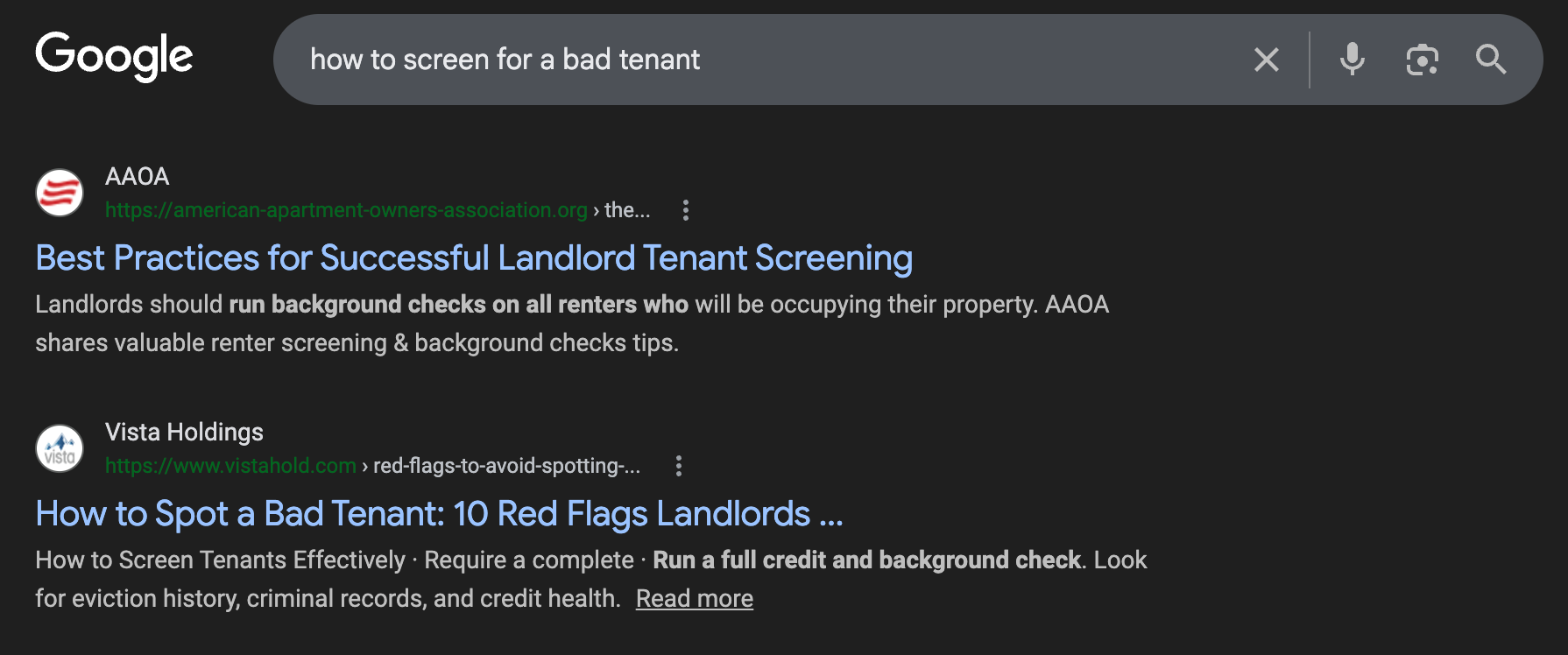
Great. Now what?
READ THE CONTENT.
Based on these two pages these are the topics we need to cover
Now here is where we go a step further. Build on these ideas. The goal should never be to just copy the same information.
Instead go further to discuss related topics that are not covered such as:
This strategy allows us to do two things
Now just keep doing this. I would highly encourage you to not churn out lots of content using AI.
While it's super tempting, the content is too polished and that's the problem. It lacks the grit of true experiences and instead is continuously a regurgitation of the same things that everyone says online.
The final stage is to connect your content back to your service
Paid advertising is the fastest way to get in front of property owners who are actively searching for management help.
Google Search Ads remains the most effective paid channel for property management leads because the intent is already there and you’re paying to be in position 1.
To find good quality CPC queries for free use Google’s Keyword Planner. It will also tell you the approximate search volumes for each term.
Once you have found a keyword such as “Property Management Services” do the same process of Googling it and READING the content.
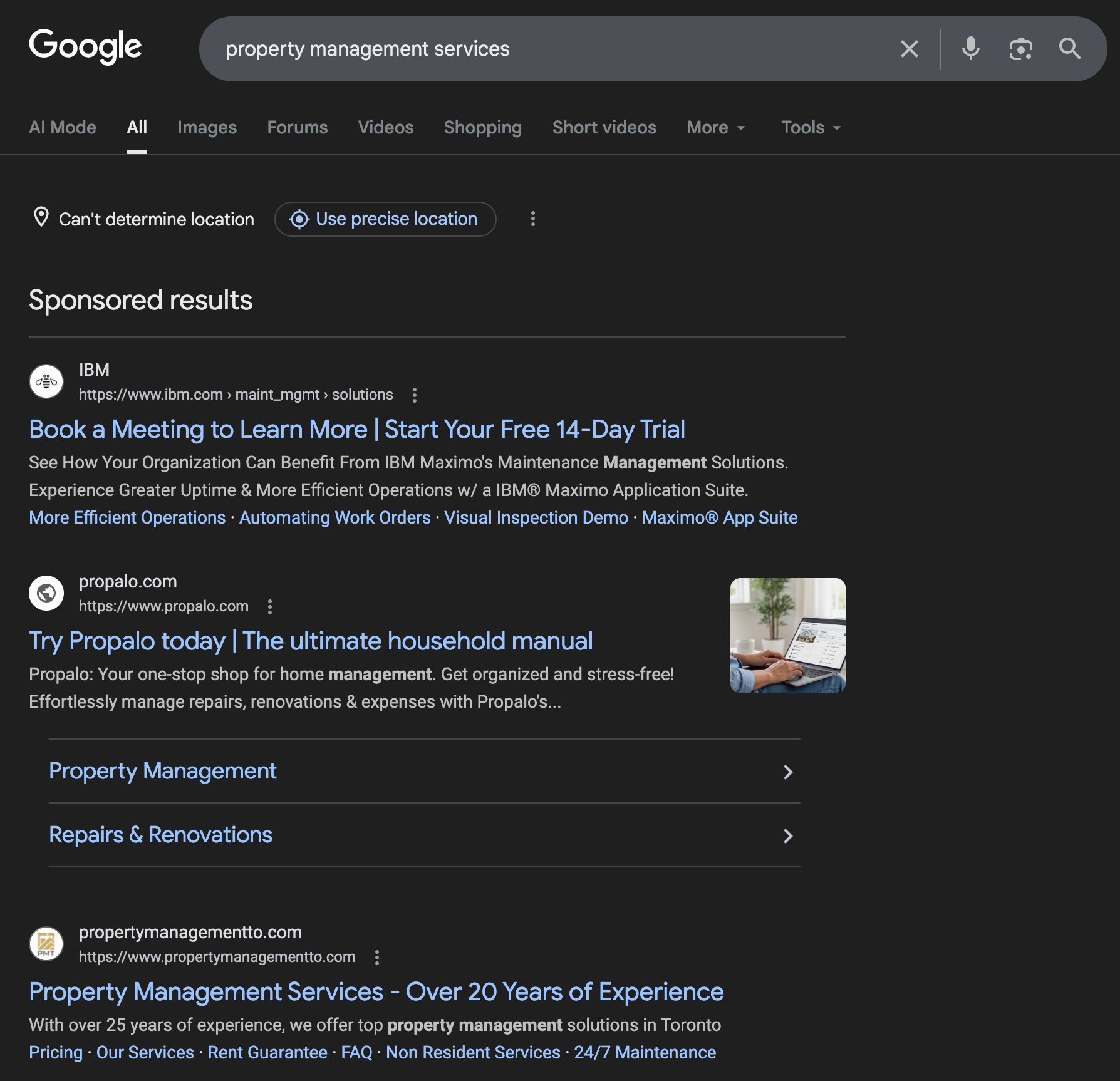
What you will notice is that all these pages have 3 things in common no matter what keyword you have
As such, these three elements are nonnegotiable.
When you get started I would encourage you to not go after the terms with the largest search volumes.
The reason? Specificity indicates strong intent.
Someone typing "property management company in [your city]" is significantly more qualified than someone googling property management company.
Cold outreach often gets a bad reputation. But when done right, it's one of the most direct paths to new property management clients.
The key is identifying the right prospects before you send your first email.
Plus, this will save you a TON of time as you won’t need to manually verify each contact. However, before you start creating your list you should identify the following
Once you know who you're reaching out to, you can craft messaging that speaks directly to their situation.
Set a follow-up schedule and stick to it. Most deals don't come from the first email, they come from the second or third.
The goal is to be persistent without spamming them.
One big problem with cold outreach is if you automate it too much your domain will quickly get flagged and all your emails will go to spam.
There are two solutions
This strategy is a volume game. Don’t expect the strongest success rate. For every 100 emails you send you may get 1-2 responses.
Referrals consistently rank as their highest-quality lead source.
The close rate on referred leads is dramatically higher as trust has already been established.
Most property managers only think about tenant, investor or landlord referrals but they’re leaving a big opportunity on the table.
Your referral network extends far beyond current clients.
Think about the vendors you work with
The best referral programs offer clear incentives.
A $250-500 referral bonus or 50% of first months rent for any successful referral
Online marketing is important but some of the best leads come from face-to-face interactions.
The events worth your time fall into a few categories.
The biggest mistake at networking events is going in with a sales mindset. Focus on being genuinely helpful.
Once you leave the event add people you met on LinkedIn with a brief personalized message.
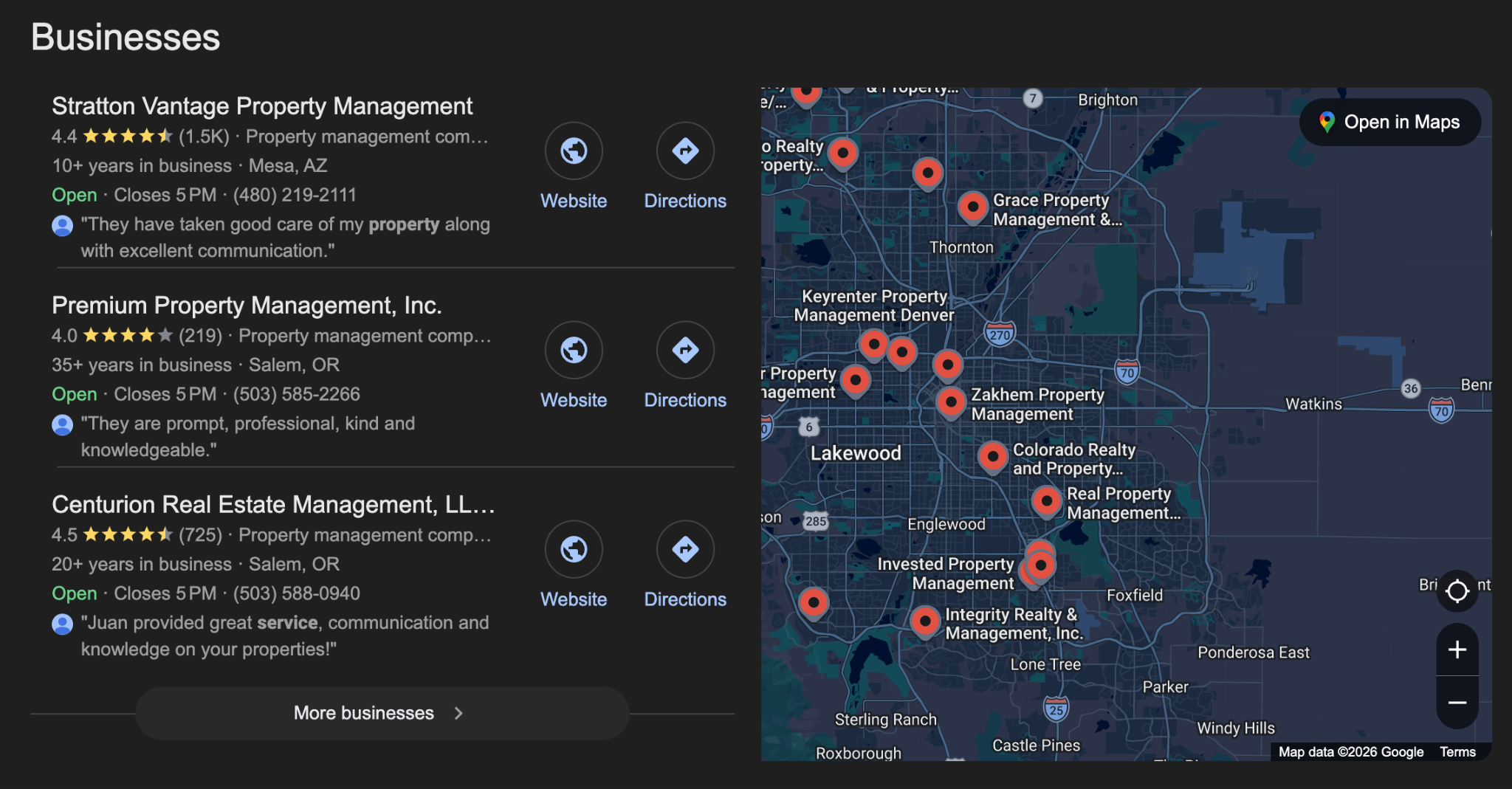
Your Google Business Profile is often the very first impression a property owner has of your company.
When someone searches "property management near me," Google's local pack (that map section at the top of results) pulls directly from these profiles. If yours isn't optimized, you're invisible in the most valuable search real estate available.
There may be situations where you receive a negative review.
Do not panic.
Instead use it as an opportunity to control the narrative.
To control the narrative and manage your reputation do the following:
Instead do the following:
The goal is to have a mix where you stand your ground where appropriate but you do not try to gaslight or make up details.
Most property management sites fail to capitalize on their traffic, relying on static forms that create a "data dilemma": they either ask for too little, resulting in incomplete lead profiles, or too much, which discourages users from converting at all.
An AI chatbot engages visitors the moment they arrive, answers their questions in real time, and captures their info.
The typical questions owners have when they hit your site? Management fees, maintenance handling, tenant screening. A good property management chatbot walks them through all of it and converts that curiosity into a booked meeting.
Go with a chatbot built specifically for real estate, not a generic one. Industry specific tools already understand property management terminology and can hold real conversations without you building every flow from scratch.
Most property management companies online look identical. Same stock photos. Same vague promises. Same blue and white color scheme. The ones winning new business have a brand that actually says something.
It's not just your logo. It's every touchpoint a property owner has with your company. Your website, your emails, your social presence, your team. If those things feel like four different companies, you've got a branding problem.
Good branding doesn't just attract more leads. It attracts the right leads.
Strategy 9: Build Strategic Realtor Partnerships
Real estate agents interact with property owners at key property decisions making them valuable referral partners.
Don’t walk in empty-handed. Professional incentives show you value their time and their "social capital." Consider offering a competitive referral structure:
Avoid the "What can you do for me?" trap. Instead, frame the partnership as a way to protect their reputation.
Don't spray and pray. Quality beats quantity when it comes to professional networks. Identify 3–5 "Investor-Focused" agents who:
Building a reliable lead engine requires more than a one-off email.
Pay per lead (PPL) platforms connect property management companies with owners who are actively looking for management services.
Unlike paid ads where you pay for clicks and hope they convert, PPL models charge you only when you receive an actual lead, a name, phone number, and some indication of what they need.
While this may seem appealing at first glance, this strategy is highly situational.
Keep in mind that Pay Per Lead is often a black box. You won’t know the quality of the leads until you actually open it up and contact them.
Additionally, their pricing structures can be vastly different with most charging a flat fee per lead while others charge that in addition to a monthly subscription.
For example, Zillow can be considered a pay per lead platform with their premier agent program. For the most part, the leads can be solid but as a result they are expensive.
With anything in real estate, if someone is promising you high volumes of leads for extremely cheap. Immediately run.
To run this strategy effectively, be ready to burn some initial cash on testing different platforms. I think a healthy budget would be $250 - 500 per platform but again expect ZERO return.
Parts of it, yes. The whole thing? No. Companies that try to fully automate end up with a pipeline full of junk leads that never convert.
To turn these automated tasks into reality, you need to master the one skill that separates property managers who save hours each week from those who give up on AI after a single frustrating attempt: the prompt.
Think of platforms like ChatGPT and Claude as highly capable assistants sitting across the desk from you — they can handle a vast range of tasks, but your results are only as good as the directions you provide. The most practical way to get moving isn't staring at an empty chat window trying to figure out what to type.
Instead, work from a proven framework using property management focused AI prompts that bridge the gap between manual work and the high-level human tasks listed below. By letting AI handle the initial drafting and data sorting, you clear the path for the work that actually requires your expertise such as tenant negotiations, portfolio strategy, and relationship building.
The conversations that actually close deals.
The follow up call.
The property walkthrough.
The face to face meeting.
No tool replaces the trust built in those moments. Automate everything around those conversations so your team can focus where it counts.
You're investing time and money to drive traffic to your property management website. But here's the question that should keep you up at night: how many of those visitors leave without ever identifying themselves?
For most property management companies, the answer is the vast majority.
Realty AI changes that.
Our AI chatbot identifies and engages anonymous website visitors, turning passive browsers into active, qualified leads. It works 24/7, answering specific real estate questions with real market knowledge all while capturing contact information.
Don't let another potential client walk away because your website wasn't able to engage them and capture their information.
Before you spend another dollar on marketing that doesn't convert, take 2 minutes to see how Madison turns your existing website traffic into a steady stream of qualified appointments.

Within just a few months, Realty AI helped Team Logue capture 15 high-quality leads, resulting in 3 new transactions worth over $3.3 million. This success generated an estimated $82,500–$95,000 in gross commission income (GCI).

Explore what Realty AI can do for your business
By contacting us you agree to both our privacy policy and our terms and conditions