Nathan SmithPublished Jun 11, 2026Updated Jun 12, 20266 min read
Most real estate agents spend too much time chasing leads that were never going to convert. A strong qualification process separates serious buyers, sellers, and renters from tire-kickers so you can focus your time on the leads most likely to close.
This guide walks you through a repeatable qualification process, the right questions to ask for each lead type, and how to use AI to automate the heavy lifting.
Step 1: Collect As Much Information As Possible at the Initial Touchpoint
Data is king. The more context you have from the first interaction, the faster you can qualify, move forward and increase your GCI.
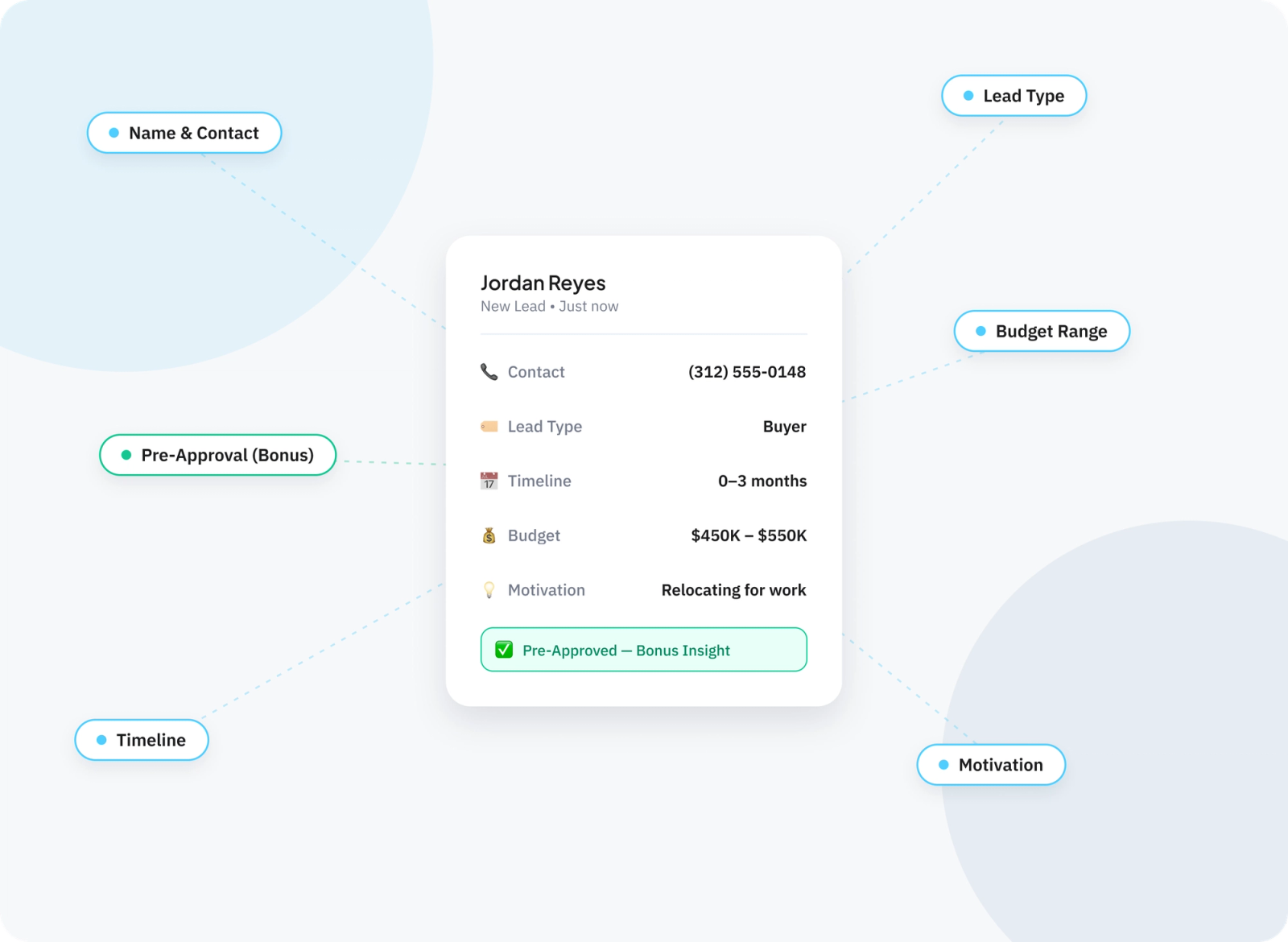
Every piece of information collected upfront reduces the number of follow-up conversations needed. Name, contact info, and timeline are the minimum. Capturing motivation, budget range, pre-approval status, and property preferences puts you ahead of most agents before you even pick up the phone.
Collect at minimum:
Name and contact info
Lead type (buyer, seller, renter)
Timeline
Budget or price range
Primary motivation
Step 2: Establish Your Qualification Process
You need a consistent framework before you start follow-up. Without one, qualification becomes inconsistent and you end up spending time on leads that should be deprioritized.
The most effective framework for real estate is MTBA:
Motivation — Why do they want to buy, sell, or rent? Life events like job changes, divorce, or a growing family are strong signals of follow-through.
Timeline — When do they need to move? Someone with a 60-day deadline is very different from someone casually browsing for next year.
Budget — What can they actually afford? For buyers, are they pre-approved? For sellers, do they have realistic price expectations?
Authority — Are you talking to the decision-maker? Many buyers have a partner, spouse, or parent involved. Knowing this early prevents surprises.
MTBA Quick Reference
Factor
What You're Assessing
Qualified Signal
Unqualified Signal
Motivation
Why they want to move
Specific life event or clear reason
Vague interest
Timeline
When they need to act
Within 90 days
6+ months with no urgency
Budget
Financial readiness
Pre-approved or realistic price range
No pre-approval, unclear finances
Authority
Decision-making power
Primary or sole decision-maker
Defers to someone else
Data point: 63.4% of website visitors are either actively searching or ready to act. Most are already qualified. The gap is capture.
Step 3: Ask Specific Questions Based on Situation
Generic questions get generic answers. Tailor your qualification questions to the lead type since buyers, sellers, and renters have different motivations and timelines.
5 Questions to Ask Buyer Leads
Most important thing to determine: financial readiness. A motivated buyer with no pre-approval or unclear budget is months away from closing. Start here.
1. Have you been pre-approved for a mortgage, or are you planning to pay cash?
2. What's your ideal price range, and is that based on a pre-approval amount or an estimate?
3. What's driving your decision to buy right now?
4. Are you currently working with any other agents?
5. When would you want to be in a new home?
Data point: 85.3% of buyers already marked as ready to act converted into leads. Qualifying budget early separates your closeable pipeline from everyone else.
5 Questions to Ask Seller Leads
Most important thing to determine: motivation and pricing reality. A seller with inflated expectations and no urgency will drain your time. Look for a clear reason to move and realistic expectations.
1. What's prompting you to sell right now?
2. Have you had any recent appraisals or valuations done on the property?
3. What price range are you hoping to list at, and how did you arrive at that number?
4. Are you currently working with another agent, or have you listed before?
5. Where are you headed after the sale?
Data point: Immediate seller intent jumped from 29.8% in Q1 2025 to 39.9% in Q2. Sellers who are ready to move act fast. Identifying motivation and timeline in the first conversation tells you whether you have a live opportunity or a long nurture.
5 Questions to Ask Renter Leads
Most important thing to determine: timeline and move-in readiness. Renters often have hard deadlines tied to a lease ending or a job start date.
1. What is your target move-in date, and do you have a hard deadline?
2. What's your monthly budget for rent?
3. Are you currently employed in the area, or are you relocating?
4. How many people will be living in the unit, and do you have any pets?
5. Have you toured any other properties yet?
Note: Renter leads are often the easiest to qualify. Someone actively searching for a rental is typically ready to move. A motivated renter with a clear timeline and deposit ready is one of the highest-intent leads you'll work with.
Step 4: Listen More Than You Talk
Your job on a qualification call is to gather information. Ask a question, then stop and listen.
Pay attention to the details leads share in passing such as a mention of a job start date, a school district they keep referencing, a budget ceiling they hedge on. These details matter and should go straight into your CRM.
Update your lead's profile after every interaction. Nothing kills trust faster than asking someone a question they already answered.
Step 5: Define and Refine Your Ideal Client Profile (Optional)
Over time, the most effective agents stop trying to work with everyone and start attracting a specific type of client they can serve exceptionally well.
This is your Ideal Client Profile (ICP).
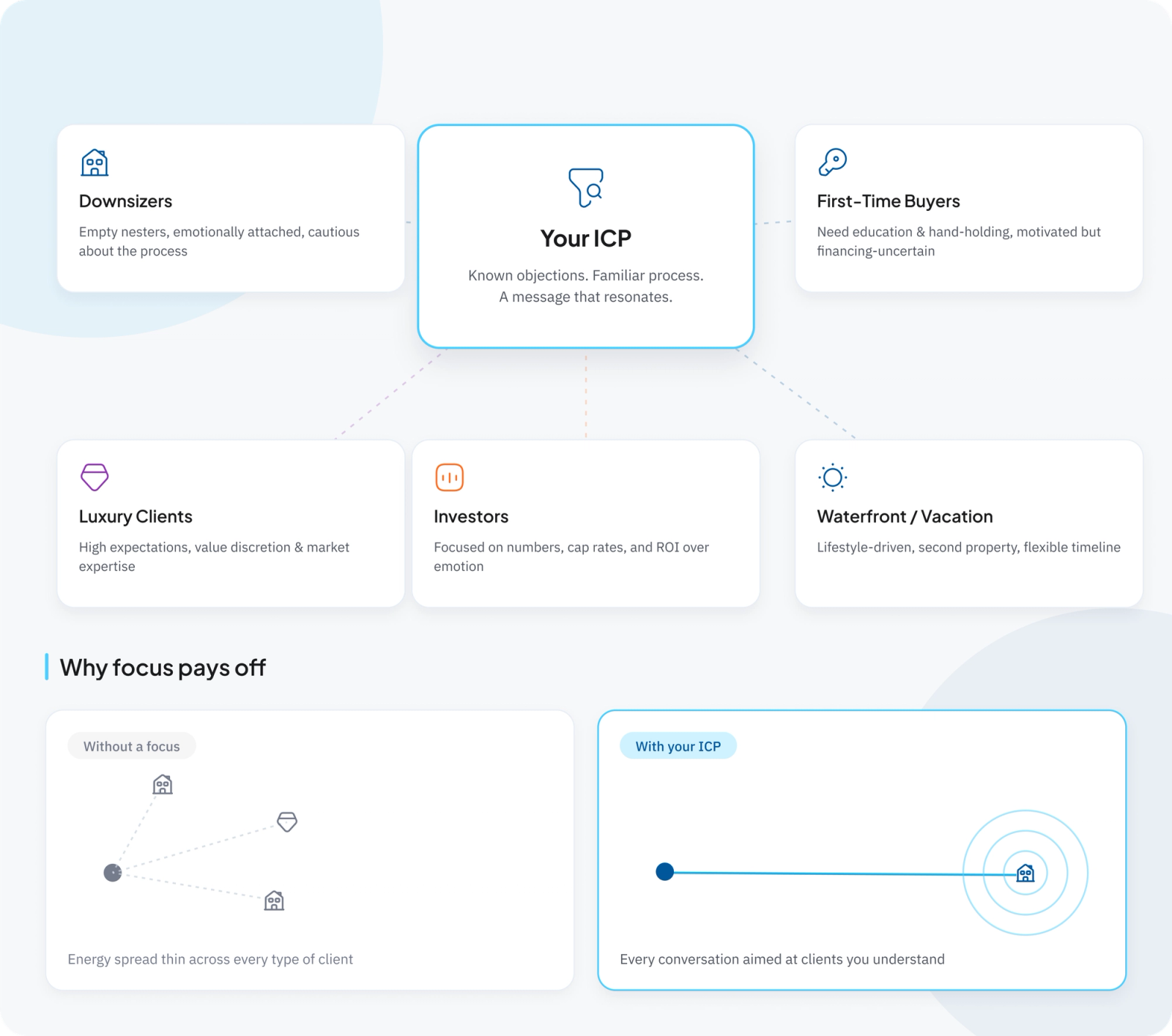
Your ICP is the type of buyer, seller, or renter where you already know the objections, understand the process, and can speak directly to their challenges. The more focused you get, the more repeatable and confident your qualification process becomes.
Examples of real estate ICPs:
Downsizers — empty nesters selling a family home and buying something smaller, often emotionally attached to the property and cautious about the process
First-time home buyers — need more education and hand-holding, highly motivated but often slowed by financing uncertainty
Luxury buyers and sellers — high expectations, value discretion, and respond to market expertise over price
Waterfront or vacation property buyers — lifestyle-driven, often purchasing a second property and operating on a flexible timeline
Investors — focused on numbers, cap rates, and ROI rather than emotional fit
Aligning your marketing and qualification process around a specific ICP means:
Objections become familiar. You have heard them before and know how to address them.
The process becomes repeatable. Every conversation follows a similar pattern, which builds confidence and speed.
Your messaging resonates. When you speak directly to a specific type of client, the right leads come to you already pre-sold on working with you.
What Are the Key Indicators of a Qualified Real Estate Lead?
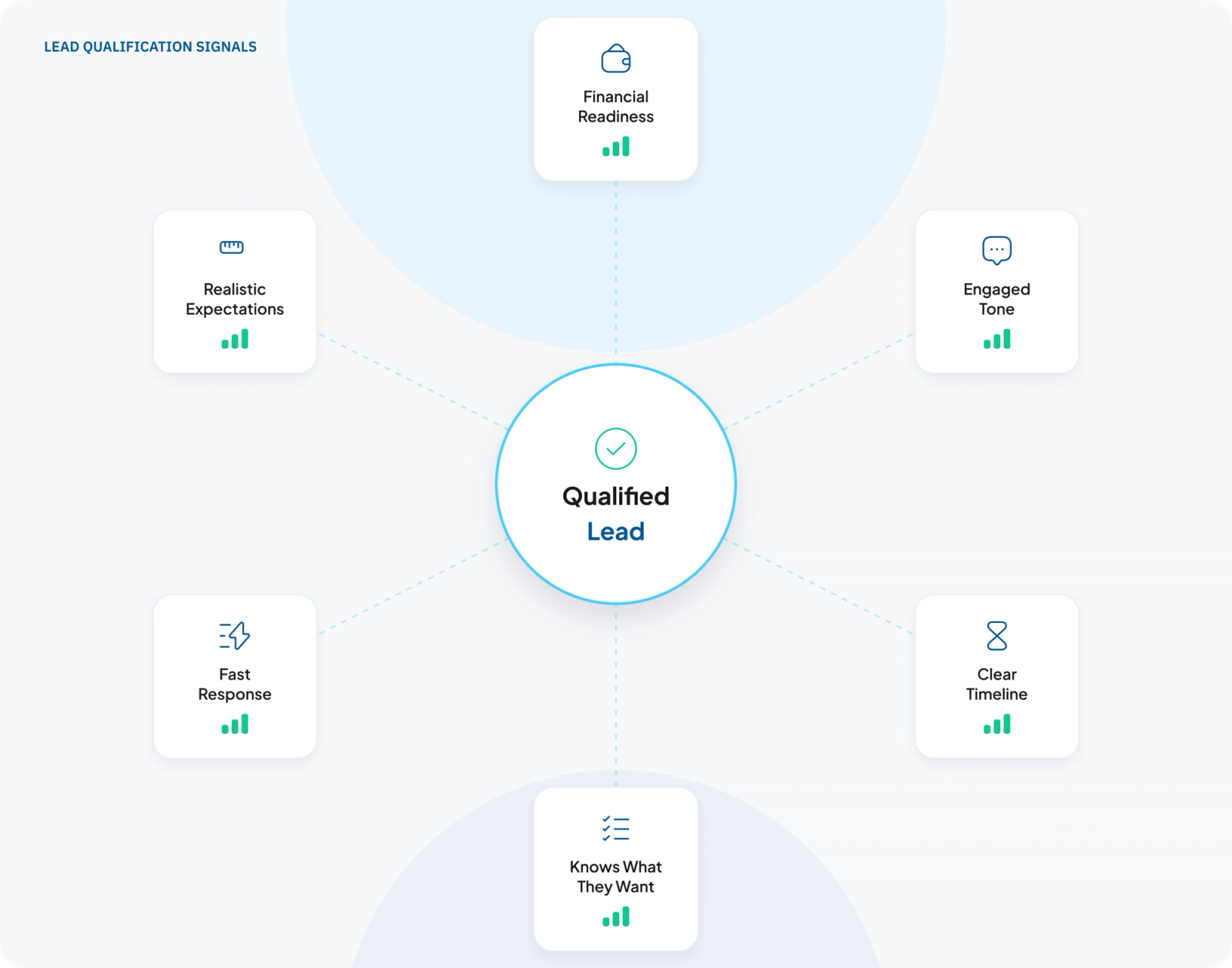
Financial Readiness: Buyers are pre-approved or have a clear budget. Sellers have realistic price expectations. Renters know their monthly budget and have a deposit ready. The financial side is not a blocker.
Tone and Engagement: They ask specific questions and respond quickly. Evasive answers or hesitation around money and timing are warning signs regardless of lead type.
Clear Motivation and a Real Timeline: They have a reason to move and a deadline. A job relocation, a lease ending, a life change. Motivation without a timeline is interest, not intent.
They Know What They Want: Buyers can describe their ideal home. Sellers know where they are going. Renters know the neighborhood and unit requirements. This level of specificity signals someone who has been researching for a while and is close to a decision.
They Respond Fast: Response time is one of the clearest signals of urgency. A lead who replies within minutes is ready to act.
Realistic Expectations: Misaligned expectations are one of the most common reasons deals fall apart late in the process. Buyers are not expecting to pay 20% below asking in a competitive market. Sellers are not insisting on a price the comps do not support. Renters are not expecting luxury finishes at entry-level prices.
Lead vs. Qualified Lead: Quick Breakdown
Factor
Cold
Warm
Hot
Motivation
No clear reason
Life event on the horizon
Urgent, specific reason to move
Timeline
6+ months or unknown
3-6 months
Within 90 days
Budget
Unknown
Estimated but unconfirmed
Pre-approved or cash ready
Decision Authority
Unknown
Involved but not sole decision-maker
Confirmed decision-maker
Responsiveness
No response or very slow
Replies within a day
Replies within minutes
Property Criteria
Broad or undefined
General preferences
Specific and researched
Next Step Readiness
Not ready
Open to a call or showing
Ready to schedule immediately
Action
Nurture until a signal changes
Stay in touch, keep educating
Call same day and book the appointment
How to Integrate AI for Real Estate Lead Scoring and Qualification
Manual qualification works but does not scale. If you are generating volume, you need a system that handles initial scoring and data capture automatically so you only spend time on leads that are already pre-qualified.
Option 1: Realty AI
Our real estate chatbot handles lead scoring and qualification automatically and keeps your CRM updated in real time.
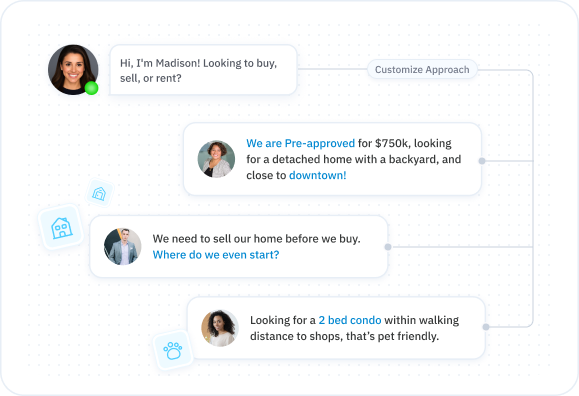
When someone arrives to your website, Madison engages them, asks the right qualification questions based on their answers, scores their readiness, and logs everything directly to your CRM.
You get notified by text and email once a lead is qualified and ready for your attention. This allows you to just focus on closing.
Pros
5-minute setup, no technical configuration required
Automatic CRM updates with lead scores and qualification data
Text and email alerts when a qualified lead is ready for follow-up
Proven conversation flows refined across thousands of real estate teams
Cons
Requires a Realty AI subscription
Results scale with website traffic, higher traffic volume means more leads for Madison to qualify and better overall outcomes
Option 2: DIY AI Automation
Building your own qualification system is possible with the right tools, but it requires upfront setup and ongoing management.
Step 1: Set up a lead capture form on your website that collects lead type, timeline, budget, and contact info.
Step 2: Connect your form to an automation platform (Make or Zapier) that passes the data to an LLM like GPT-4 or Claude. The LLM evaluates the responses, scores the lead, and identifies any follow-up questions still needed.
Step 3: Update your CRM automatically from the LLM output so every lead has a score and context before you ever reach out.
Step 4: Connect a qualification flow to both an email inbox and a phone number. Set up separate sequences for each channel that ask the remaining qualification questions and log answers back to your CRM as responses come in.
Pros
Fully customizable to your workflow
Can be built on tools you may already use
No dependency on a third-party real estate platform
Cons
Requires ongoing self-management
Additional API costs for LLM credits and automation platforms
Significant upfront configuration time
Debugging and maintenance are your responsibility
Start Qualifying Leads the Right Way
A consistent qualification process means less time chasing and more time closing. Ask the right questions, listen well, and keep your CRM updated after every interaction.
If you want to automate the entire process, Realty AI's Madison chatbot handles qualification, scoring, and CRM updates for you out of the box.
Book a demo to see how Realty AI qualifies leads automatically and notifies you when they are ready to close.
Related articles
More in SEO & Marketing
Keep reading in the same category to go deeper on the topics that matter to your team.
Answer engine optimization explained for real estate: how AI answers pick their sources, what to publish, what to measure, and the fair housing line to stay behind.
Generative engine optimization for real estate teams: how to get cited by ChatGPT, Gemini and AI Overviews, with a checklist and the data behind it.
About Madison
The AI assistant built for real estate lead gen
Madison is Realty AI's conversational assistant for real estate websites. It engages visitors instantly, qualifies buyers, sellers, and renters through natural dialogue, routes summaries to your CRM, and keeps your team focused on closing.
5.0 average from 2,500 customer reviews
“We captured 3 new transactions worth over $3.3 million in just a few months using Realty AI.”
Sarah Logue
Broker & Owner, Top 0.1%
“Within our first week of using Realty AI, I had an engaged seller ready on the phone. This has never happened before in 4 years.”
Mark Jensen
Owner & Broker of Record
“It feels like having a personal assistant on my website 24/7, sending me instant notifications so I never miss a potential client.”