Customer Service in Real Estate: 9 Ways to Turn Happy Clients Into Repeat Clients
Customer service in real estate decides whether a happy client hires you again or quietly picks someone else next time. This post covers the 9 habits that close that gap, backed by fresh data on what clients say versus what they do.
Great real estate customer service is mostly unglamorous: answering every inquiry, keeping clients informed, and staying in touch after closing. The agents who do it consistently earn the referrals and repeat deals that everyone else chases with ads.
Here's what we'll cover:
What customer service means in real estate, and why "client" and "customer" aren't the same thing.
The loyalty gap, the distance between satisfied clients and repeat clients.
9 customer service tips aimed at the moments where agents most often lose people.
Where AI fits, and where a person still needs to take over.
How to measure your service, so you know whether it's improving.
FAQs drawn from what people search for on this topic.
Most of these tips depend on you, but the first one, fast response, is where an AI chatbot can cover the hours you can't.
Let's get started.
What Is Customer Service in Real Estate?
Customer service in real estate is how you treat people at every point of contact, from the first inquiry to the years after closing.
It covers responsiveness, communication, advice, and follow-through, not only the transaction itself.
It matters more here than in most industries because the stakes are unusual. A home is often the largest purchase a person makes, and the process is slow, stressful, and full of unfamiliar steps.
Client vs. Customer in Real Estate: What's the Difference?
Agents usually call the people they represent clients and the people they serve without representing customers.
The difference is legal, not just polite: a client relationship typically carries fiduciary duties, while a customer relationship does not.
Column 1
Client
Customer
Relationship
Signed agency agreement, such as a listing or buyer agreement
No representation agreement
Duties owed
Fiduciary duties such as loyalty, confidentiality, disclosure, and reasonable care
Honesty and fair dealing
Example
A seller whose home you've listed
An unrepresented buyer touring your listing
What you can offer
Advocacy, strategy, and negotiation advice
Factual information, without advocacy
Agency rules differ by state and province, so confirm the specifics with your broker or licensing regulator. Either way, both groups deserve excellent service, since today's customer is often next year's client.
Why Customer Service Matters in Real Estate
Service is your marketing, because most business arrives through people you've already served. In NAR's 2023 Profile, 43% of buyers found their agent through a referral from a friend, neighbor, or relative, and 26% of sellers used an agent they'd worked with before.
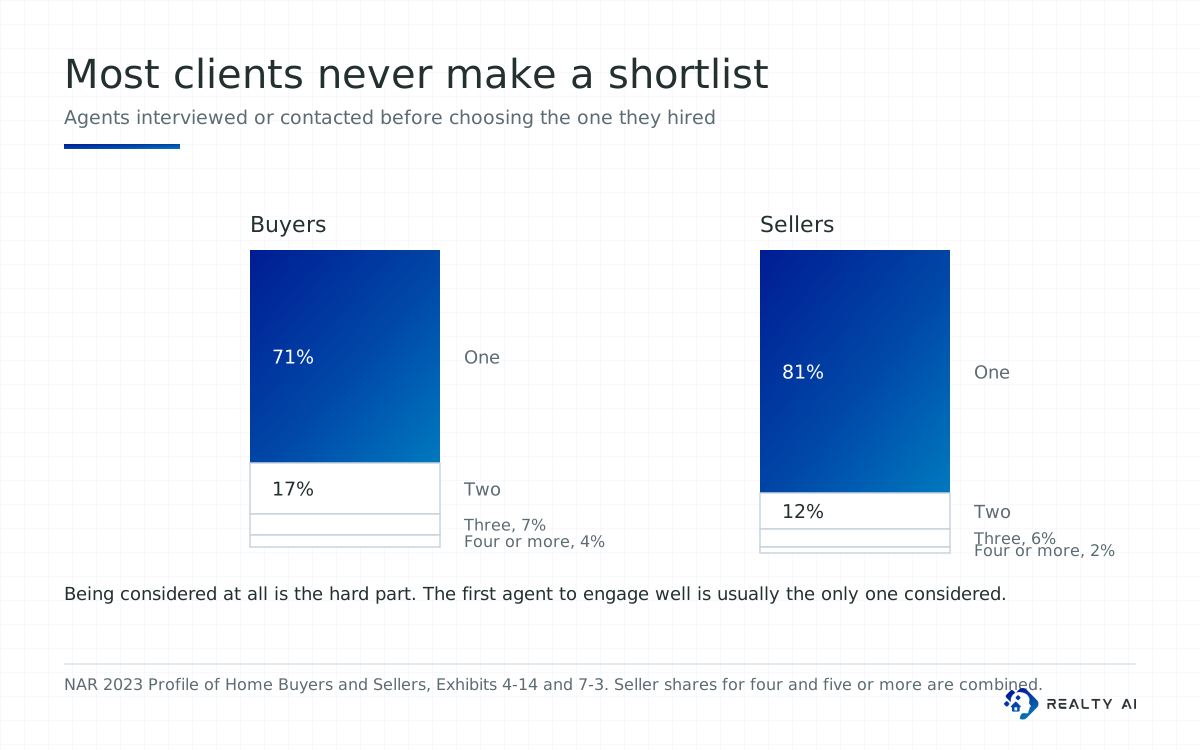
Clients also rarely shop around. Seventy-one percent of buyers interviewed only one agent, and 81% of sellers contacted only one, so the first agent to engage well usually wins the business.
The reverse is also true. Slow replies and dropped follow-ups show up again and again among the top reasons real estate brokerages lose leads, long before price or marketing come into it.
The Loyalty Gap: Why Satisfied Clients Don't Always Come Back
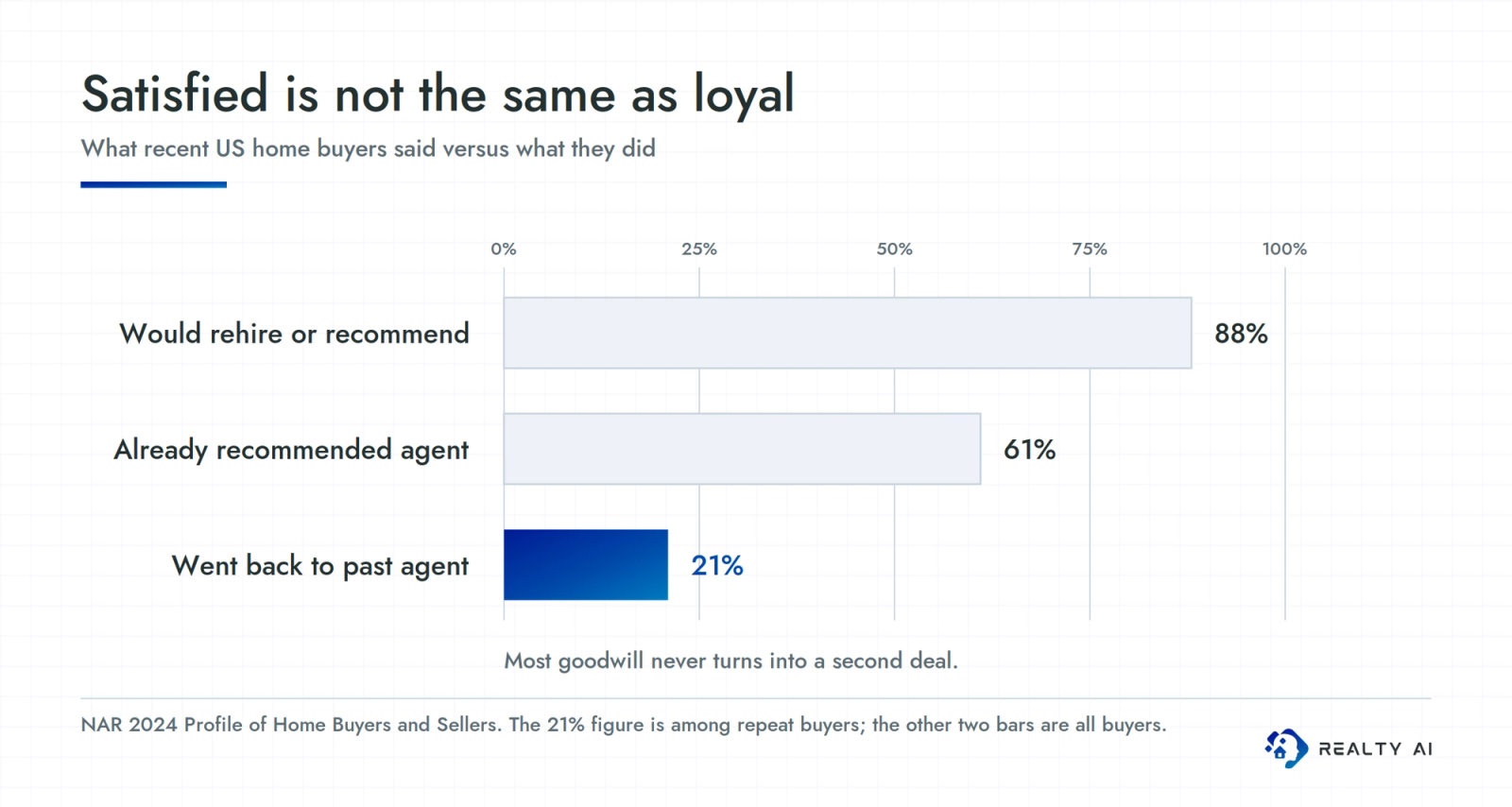
Satisfaction at closing does not turn into repeat business on its own. In NAR's 2024 Profile, 88% of buyers said they would use their agent again or recommend them, yet only 21% of repeat buyers went back to an agent they had worked with before.
Referrals leak too. In the 2023 data, 30% of buyers and 40% of sellers had not recommended their agent even once since the sale.
Most customer service advice treats closing as the finish line. The data suggests it's closer to the starting line: satisfaction is how a client feels at closing, while loyalty is what your follow-up does in the years after.
9 Customer Service Tips for Real Estate Agents
The tips follow the client journey, from first inquiry to years after closing. Each one targets a moment where agents commonly lose people.
1. Respond to Every Inquiry, Fast
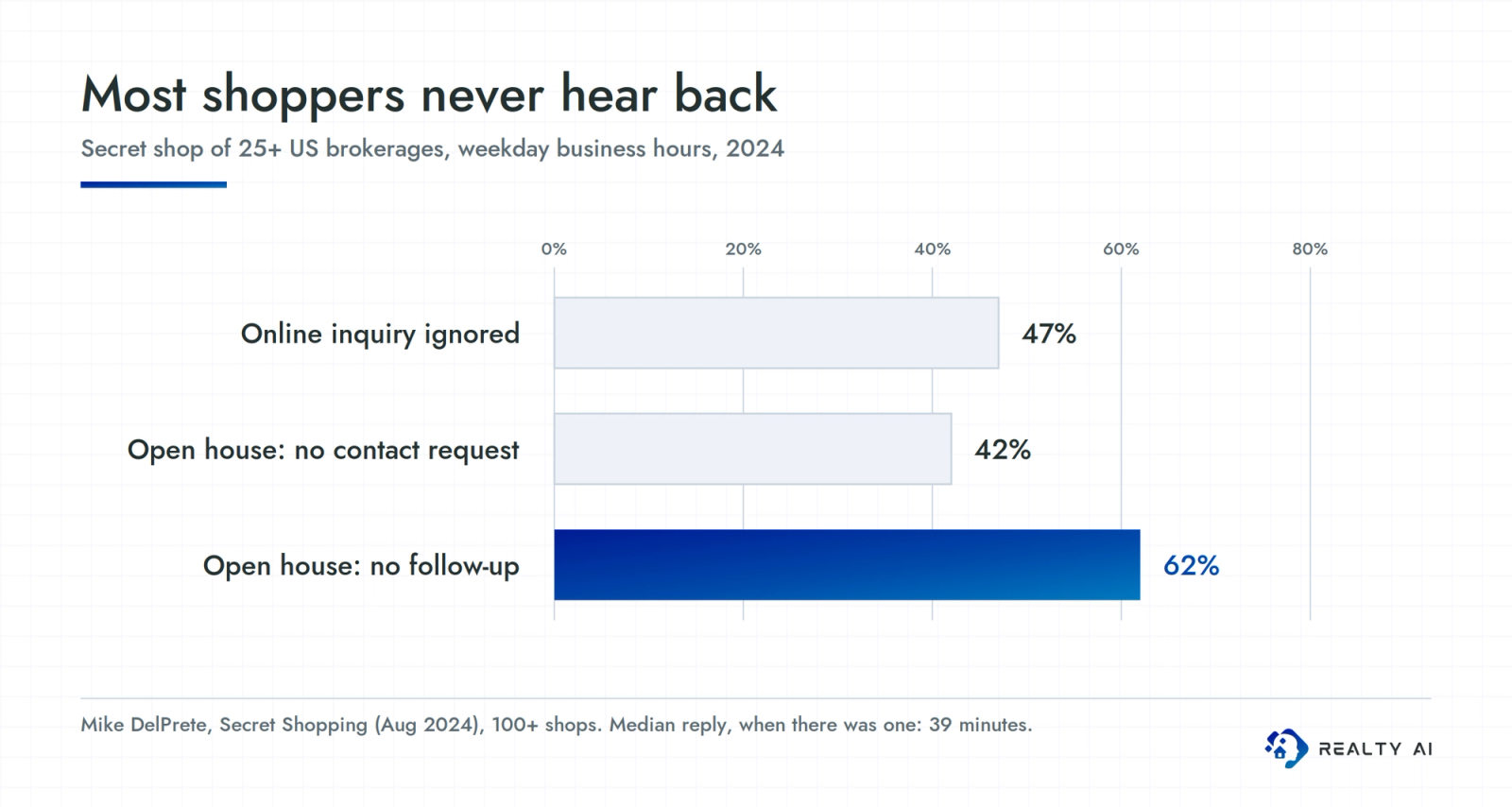
Speed to lead, the time between an inquiry and your first reply, is the first service moment a client experiences. The bigger problem isn't slow replies, though; it's no reply at all.
Those ignored messages aren't idle browsing. In Realty AI's analysis of 31,000 website conversations in Canada during 2025, nearly two-thirds of people were already searching or ready to act when they started the chat.
What to do:
Acknowledge every inquiry within minutes, even if the full answer takes longer.
Answer the question they asked before asking for their details.
Cover nights and weekends with a teammate, an ISA, or software, so no channel goes dark.
If software handles that first layer, check how quickly it replies and what it does when it hands off to you. The goal is a reply in seconds and a human in minutes.
2. Set Communication Expectations on Day One
Agree on how often you'll update the client, on which channel, and what counts as urgent before the first showing or listing appointment. Clients rarely complain about the update schedule they agreed to; they complain about silence they didn't expect.
Use a short script like this at your first meeting:
Plain text
Before we start, let's agree on how we'll stay in touch.

- Updates: I'll send a short update every [Monday and Thursday], even if nothing has changed.
- Channel: Do you prefer text, email, or a call for routine updates?
- Urgent news: Offers, inspection results, and deadline changes get a phone call the same day.
- Response time: I reply within [2 business hours]. After [8 pm], expect a reply the next morning unless it's urgent.
- Your turn: Is there anything you'd like me to do differently from agents you've worked with before?
3. Meet Clients on the Channels They Already Use
Buyers in NAR's survey also rated texting and instant property alerts as important communication habits. Many clients now start conversations on your website, Instagram, or WhatsApp rather than by phone.
Service breaks down when those messages land in five different apps and one of them goes unchecked for a week. Omnichannel platforms such as AeroChat pull web chat, WhatsApp, Instagram, Messenger, and email into one inbox, which makes it harder for a message to slip through.
Keep the standard the same on every channel: same response time, same tone, and a clear move to a phone call when the conversation gets complex.
4. Listen First, Then Answer the Specific Question
Most inquiries are specific, so a generic reply feels like no reply. In Realty AI's 2025 conversation data, over 72% of location-specific conversations referenced an exact address or a named neighborhood, and more than 60% of interactions were about property search, pricing, agent contact, or listing details.
Ask one clarifying question, restate what you heard, and then answer. The same questions that clarify a request also help you qualify a real estate lead without it feeling like an interrogation.
Repeat back the key detail, such as the address, budget, or move date, so the client knows you heard it.
Take notes in your CRM, so the next conversation starts where the last one ended.
5. Explain the Process Before Clients Have to Ask
Anticipating needs is mostly about explaining what's coming next. In NAR's 2024 data, 53% of buyers said their agent helped them understand the buying process, and 80% of first-time buyers called that help invaluable.
Send a one-page timeline at the start that shows each stage and roughly how long it takes.
Preview the next step at every milestone, so nothing arrives as a surprise.
Translate jargon like contingency, escrow, and earnest money into plain language the first time it comes up.
Summarize every document you send in one line that explains what it is and whether they need to act.
6. Be Available After Hours Without Burning Out
Clients browse homes and send questions in the evenings and on weekends, after their own workday ends. Being reachable then is part of the job, but being personally on call at all hours isn't sustainable.
Split the work: a system or teammate handles the instant reply and routine questions, and you handle anything that needs judgment.
If you're deciding between a person and software for that first layer, compare a website chatbot vs. an ISA on cost and coverage.
Put your boundaries in the communication agreement from tip 2. After-hours coverage shouldn't mean after-hours burnout.
7. Handle Difficult Clients and Bad News Calmly
Difficult conversations come with the job: low appraisals, failed inspections, lost bidding wars. How you deliver bad news often matters more to the relationship than the news itself.
A simple sequence works for most tense moments:
Listen fully before you respond, even if you already know the answer.
Acknowledge the frustration without getting defensive.
Restate the problem in your own words, so the client knows you understand it.
Offer two or three options with the tradeoffs of each.
Confirm next steps in writing the same day.
Call first for bad news, then follow up in writing. A message like this keeps the call focused:
Plain text
Hi [Name], I have news on [the appraisal] and wanted you to hear it from me first.

The appraisal came in at [$X], which is [$Y] below the contract price.

Here are the options we have:
1. [Ask the seller to reduce the price to the appraised value.]
2. [Meet in the middle and cover part of the gap.]
3. [Request a reconsideration with additional comparable sales.]

I'd like to talk these through by phone today. What time works for you?
8. Keep the Transaction Transparent
Clients trust what they can see. In NAR's 2023 survey, 98% of buyers rated an honest agent with integrity as very important, more than any other quality they looked for.
Share offers, inspection findings, and deadlines as they happen, not in a weekly batch.
Send sellers a weekly activity report covering showings, feedback, and online interest.
Explain the work clients can't see, such as calls with the other agent or the lender.
Raise problems early, with a plan, rather than waiting until you have a perfect answer.
9. Follow Up After Closing
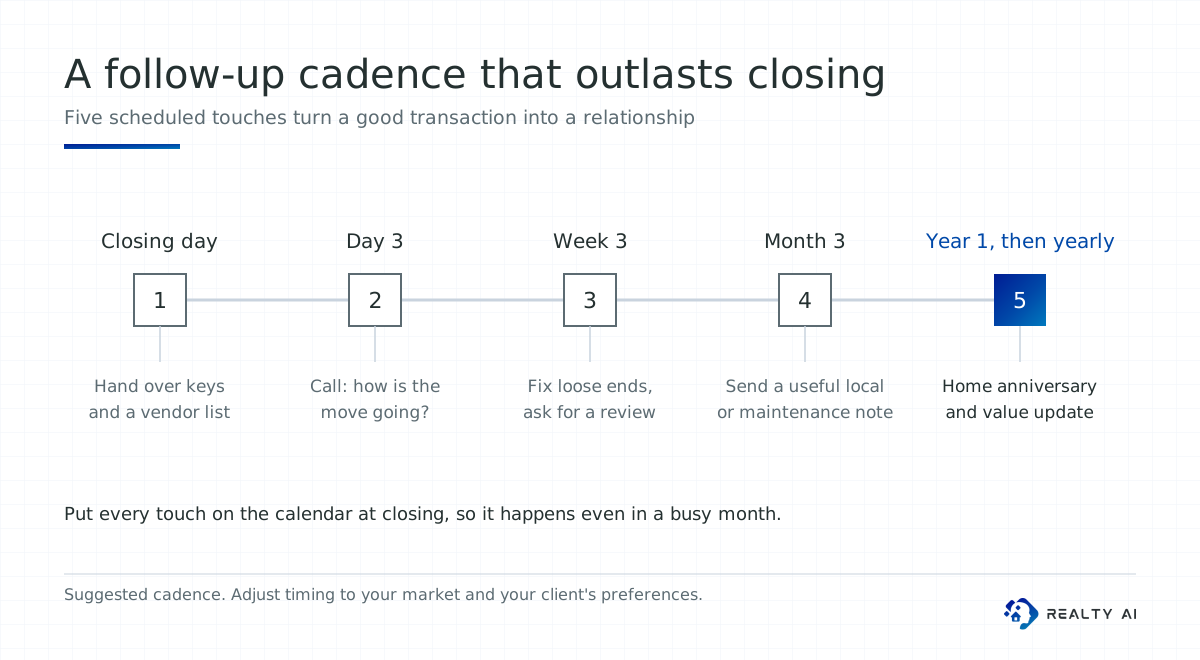
Post-closing follow-up is the tip most agents know and the one they most often let slide. The fix is to schedule it at closing, while the relationship is at its warmest.
Make each touch useful rather than salesy. A maintenance reminder, a property tax deadline, or a trusted contractor's number gives the client a reason to open your message.
Automate the routine touches with real estate email marketing and save phone calls for the personal ones. The calendar does the remembering, and you do the relationship.
Not every lost repeat client is a service failure. People move away, and in NAR's 2023 data, sellers who moved farther were less likely to reuse an agent.
Distance only explains part of it, though. Even among sellers who moved 10 miles or less, only 29% used an agent they'd worked with before.
Where AI Fits in Real Estate Customer Service
AI is best at the parts of service that need speed and consistency: instant first replies, answers to common listing questions, showing requests, and routing leads to the right agent.
People are better at judgment, negotiation, and hard conversations.
The handoff is the part to get right. Before you choose a tool, ask what happens when it can't answer a question, because a dead end is worse than a slow reply.
Two guardrails keep AI from hurting the service it's meant to improve:
Be clear that it's automated. Clients are fine talking to a bot when they know it's a bot and can reach a person.
Keep every reply fair housing compliant. Describe the property and the area, never who should live there.
Automated tools are held to the same standard as agents, since fair housing rules apply to a chatbot's wording too. Review your chatbot's scripts with your broker the same way you'd review ad copy.
How to Measure Your Real Estate Customer Service
Most agents never measure their service, so they can't tell whether it's getting better. Track a handful of numbers each month:
Metric
How to track it
What to aim for
Response rate
Share of inquiries that get any reply
Every inquiry, on every channel
Median first response time
CRM or inbox timestamps
Minutes, not hours
Follow-up rate
Share of leads and open house visitors contacted again
All of them, on a schedule
Referrals per closed client
Ask every new client how they found you
Rising year over year
Repeat client rate
Past clients who hire you again
Above NAR's 21% repeat-buyer figure
Reviews
Google Business Profile and portal reviews
A steady flow of recent reviews
Then secret shop yourself once a quarter. Send an inquiry through your own website, visit your own open house as a stranger would, and time the response.
FAQ
What are the five rules of customer service?
Common versions include responding quickly, listening before talking, being honest, keeping promises, and following up. For real estate agents, the first and last rules are where most service breaks down.
How do you handle difficult customers?
Listen fully, acknowledge the frustration, and restate the problem so the person knows you understand it. Then offer clear options and confirm the next step in writing.
Can you give me an example of excellent customer service in real estate?
A buyer's inspection turns up a failing water heater late on a Friday. An agent providing excellent service calls that evening, explains the options, gets a plumber's quote before Monday, and sends a written summary so the buyer can decide calmly.
The Bottom Line
Customer service in real estate isn't a personality trait; it's a system of fast replies, agreed communication, and follow-up that continues long after closing. Most clients already like their agent, and the agents who win repeat business are the ones who stay in touch.
Want every website inquiry answered in seconds, day or night? Book a demo and see how Realty AI handles the first reply so you can focus on the relationship.
Related articles
More in RE Operations
Keep reading in the same category to go deeper on the topics that matter to your team.
The best real estate recruiting chatbot and AI recruiting tools in 2026, compared. Real features, pros and cons, and the compliance rules brokerages miss.
Maximize lead conversion with a Real Estate ISA. Learn the 2026 costs, AI integration, and the "handoff" secrets to ensure appointments turn into closings.
About Madison
The AI assistant built for real estate lead gen
Madison is Realty AI's conversational assistant for real estate websites. It engages visitors instantly, qualifies buyers, sellers, and renters through natural dialogue, routes summaries to your CRM, and keeps your team focused on closing.
5.0 average from 2,500 customer reviews
“We captured 3 new transactions worth over $3.3 million in just a few months using Realty AI.”
Sarah Logue
Broker & Owner, Top 0.1%
“Within our first week of using Realty AI, I had an engaged seller ready on the phone. This has never happened before in 4 years.”
Mark Jensen
Owner & Broker of Record
“It feels like having a personal assistant on my website 24/7, sending me instant notifications so I never miss a potential client.”