Nathan SmithPublished Dec 12, 2025Updated Sep 15, 20269 min read
TLDR: A real estate blog compounds into a lead engine - but only on WordPress, with SEO-optimized niche content, long-tail keyword targeting, consistent publishing (even monthly), internal topic clusters, and unique local market insights drawn from real experience rather than generic advice competitors can copy.
Most real estate professionals are still relying on outdated marketing tactics while their competitors are quietly building authority and capturing leads through strategic content.
If you've been thinking about starting a real estate blog but aren't sure where to begin, you're in the right place.
Why Should You Start a Real Estate Blog In 2026?
Here's what I discovered after auditing hundreds of real estate websites, the agents dominating their markets aren't the ones with the flashiest websites or the biggest advertising budgets.
They're the ones consistently publishing valuable content that answers the exact questions their ideal clients are searching for.
The biggest mistake new real estate bloggers make? Trying to be everything to everyone. You'll burn out creating content and attract an audience that never converts.
When you focus on a specific niche, you become the obvious choice for that audience.
Profitable real estate niches to consider:
First-time homebuyers in your specific metro area need hand-holding through the entire process. They're searching for content about down payment assistance, mortgage pre-approval, and what to expect at closing.
Luxury property buyers want insider market intelligence, investment potential analysis, and exclusive neighborhood insights you won't find on Zillow. If you want to become a luxury real estate agent, blogging about high-end properties and exclusive neighborhoods positions you as the authority in this premium market.
Real estate investors are hungry for cash flow analysis, market timing strategies, and tax optimization tactics. This audience values depth over fluff.
How to identify your ideal niche:
Start with your existing expertise and client base.
What questions do you answer repeatedly? What types of transactions do you enjoy most? Your niche should align with both your knowledge and genuine interest, you'll be creating content about this topic for years.
Then validate market demand.
Are people actually searching for this information? Use keyword research tools to confirm sufficient search volume exists.
Step 2: Choose a Blogging Platform
Step 3: Set Up Domain & Hosting
Your domain name is your digital real estate, choose wisely because changing it later damages all the SEO equity you've built.
The best real estate blog domains immediately communicate what you offer.
Avoid clever wordplay that confuses potential visitors.
Keep it short (under 15 characters if possible), easy to spell, and free of hyphens or numbers.
Test it verbally, if you have to spell it out every time you mention it, choose something simpler.
Choose reliable hosting
Your hosting provider determines your site speed, uptime, and scalability.
Step 4: Plan Your Content Strategy
Random blog posts won't build your business. You need a strategic approach that converts readers into clients.
Identifying what your audience actually searches for
Your content strategy starts with local keyword research, but not the way most agents do it. Don't just target "real estate tips" or "home buying advice", those phrases are too competitive and too vague to convert.
Instead, identify the specific questions your ideal clients ask at different stages of their journey. Build content clusters around these buying journey stages:
Awareness (just starting to consider buying or selling)
Consideration (actively comparing options)
Decision (ready to choose an agent or make an offer).
Step 5: Write High-Quality, SEO-Friendly Content
Content that ranks in Google while actually helping readers requires balancing technical optimization with genuine value. Most real estate blogs fail at both.
Start with search intent.
What does someone searching for this phrase actually want to know? A person searching "best neighborhoods in Nashville for families" wants specific recommendations with details about schools, safety, and amenities, not a generic overview of why Nashville is great.
Use descriptive subheadings that promise specific outcomes.
Break up long paragraphs.
Include bulleted lists for easy reference.
Most readers scan before deciding whether to read fully.
Your SEO-Friendly Content Checklist:
Before you hit publish, run through this checklist to ensure your content is optimized for both search engines and readers:
Target keyword appears in your title tag (preferably toward the beginning)
Keyword is included in the first 100 words of your content naturally
At least one H2 or H3 subheading contains your target keyword or close variation
Meta description is compelling and under 155 characters with a clear benefit
URL is short, descriptive, and includes your main keyword (example: /best-nashville-neighborhoods-families)
All images have descriptive file names (neighborhood-park-nashville.jpg instead of IMG_1234.jpg)
Every image includes alt text that describes the image and incorporates keywords when relevant
Content includes 3-5 internal links to related posts using descriptive anchor text
Subheadings are descriptive and scannable (they should make sense if read in isolation)
Content answers the search query completely without requiring visitors to check other sources
You've included unique insights from your local market experience, not just generic information
You've included at least one bulleted or numbered list for easy scanning
You've included a call to action to connect your content to your services
Step 6: Promote Your Blog
Publishing great content means nothing if no one sees it. Smart promotion amplifies your reach and accelerates results.
Choose one or two social platforms where your audience actually spends time (Facebook and Instagram work best for most real estate niches)
Share blog content multiple times with different angles, headlines, quotes, or statistics across several weeks
Partner with local businesses, community organizations, and professionals to build backlinks through guest posts and community engagement
Use strategic Facebook ads targeted to your geographic area while building organic traffic, but only promote cornerstone content that demonstrates expertise and captures leads effectively
Step 7: Analyze & Improve
The difference between bloggers who quit after six months and those who build thriving businesses?
Data-driven optimization.
Set up essential free analytics tools
Google Analytics 4 shows what's working, which posts attract traffic, where visitors come from, how long they stay, and which pages convert into leads.
Google Search Console reveals what people search to find you, which pages rank for which keywords, and technical issues hurting your performance.
Set up both tools immediately. You can't improve what you don't measure.
How To Write Great Content For a Real Estate Blog
Great content solves real problems with specific, actionable advice drawn from genuine experience.
Start with stories, not statistics: Generic market data doesn't differentiate you. The story of how your buyer client discovered a hidden gem in a competitive market and won the offer creates memorable, valuable content.
Answer questions completely: If someone searches "how to prepare for a home inspection," they want a comprehensive checklist, not a 300-word overview. Incomplete answers send readers to your competitors.
Show, don't just tell: Include real examples from your market. Actual sale prices in specific neighborhoods. Concrete timelines from listing to closing. Detailed budget breakdowns. Add screenshots, photos, or videos when they enhance understanding.
Maintain a consistent, authentic voice: Write like you talk to clients in person, professional but approachable, knowledgeable but not condescending. Avoid jargon unless you immediately explain it.
Advanced Tips to Secure More Organic Traffic to Your Blog
Once you've mastered the basics, these advanced strategies separate growing blogs from stagnant ones.
Tip 1: Target Long Tail Keywords
While everyone else fights for "Denver real estate," smart bloggers are dominating "best neighborhoods in Denver for remote workers" and "Denver investment properties under 400k."
Why long tail keywords convert better:
These specific phrases indicate clear intent. Someone searching "how to buy a house" is exploring options. Someone searching "how to buy a house in Austin with 5% down as a teacher" knows exactly what they need.
Long tail keywords face less competition, rank faster, and attract visitors closer to making decisions.
Tip 2: Cluster & Internally Link Related Content Together
Topic clusters organize your content like a comprehensive resource library instead of disconnected blog posts. The real power comes from strategically linking these related pieces together.
Start by creating pillar content, which are comprehensive guides on broad topics like "Complete Guide to Buying Your First Home in [Your City]."
This becomes your authoritative resource on the topic.
Then create cluster content, which are detailed posts on specific subtopics like:
"First-time buyer programs in [Your City]"
"What to expect during home inspection"
"How to compare mortgage offers"
Each cluster post links back to the pillar page and to related cluster content, creating a web of interconnected resources that search engines love.
Tip 3: Add Schema Markup To Your Content
Most real estate bloggers ignore schema markup because it sounds technical. That's your opportunity.
Real estate schema markup is code that helps search engines understand your content's context and structure. It doesn't guarantee featured snippets or rich results, but it significantly improves your chances.
For real estate blogs, BlogPosting marks up blog posts, FAQPage schema can highlight Q&A content, and RealEstateAgent schema identifies your real estate business information.
While schema won't magically boost rankings, it helps your content appear with enhanced features in search results that can increase click-through rates.
What To Avoid When Starting a Blog
These common mistakes have killed more real estate blogs than lack of writing talent or SEO knowledge.
Thin, Unhelpful Content
Publishing 300-word posts that barely scratch the surface wastes everyone's time.
Search engines can't rank content that doesn't substantially cover a topic.
If you're providing less information than the posts already ranking, why would Google promote yours?
Readers feel frustrated when content promises solutions but delivers generic platitudes. They leave immediately and never return.
Aim for depth, not length for its own sake.
Some topics require 2,000 words to cover properly. Others only need 800. The standard is comprehensive coverage, not arbitrary word counts.
Copying Everyone Else on the SERP
Looking at top-ranking posts for research makes sense. Replicating them exactly makes you irrelevant.
When every post about "best neighborhoods in [city]" lists the same five neighborhoods with nearly identical descriptions, you're not adding value.
You're creating noise.
Search engines increasingly reward fresh perspectives and original information. If your content is indistinguishable from existing results, it won't outrank them.
An Inconsistent Publishing Schedule
Starting strong with weekly posts for two months, then disappearing for three months, then sporadically publishing random content won't build anything sustainable.
Be honest about your capacity.
If you can only write one comprehensive post monthly while managing your real estate business, commit to that schedule and maintain it.
Batch content creation during slower business periods and repurpose content across formats.
Examples of Successful Real Estate Blogs
These real-world examples demonstrate what's possible when you combine strategic content with consistent execution.
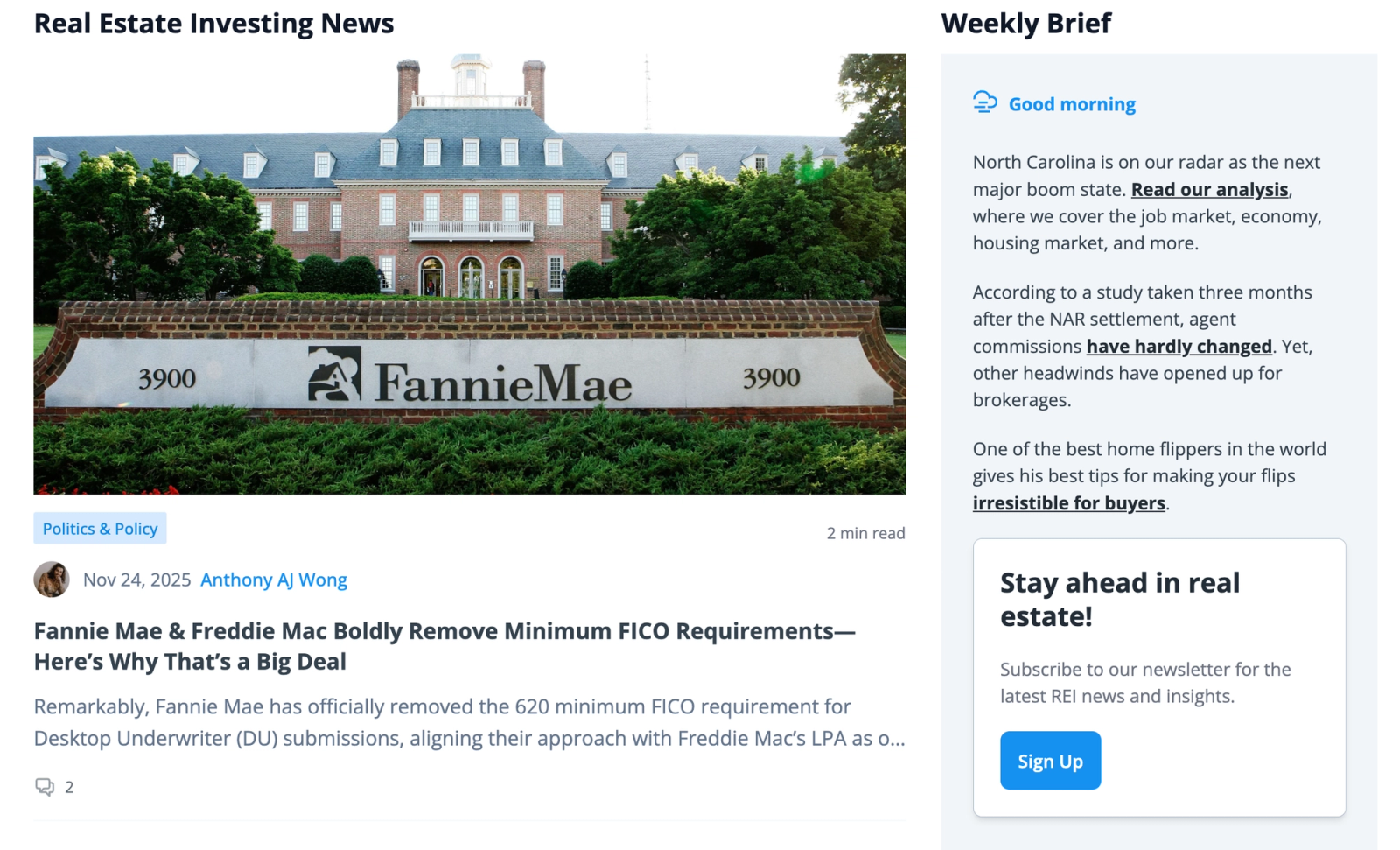
BiggerPockets
BiggerPockets dominates real estate investing content through community-driven depth and comprehensive resource libraries.
They've built topic clusters around every aspect of real estate investing, with pillar content linking to dozens of detailed posts on specific subtopics.
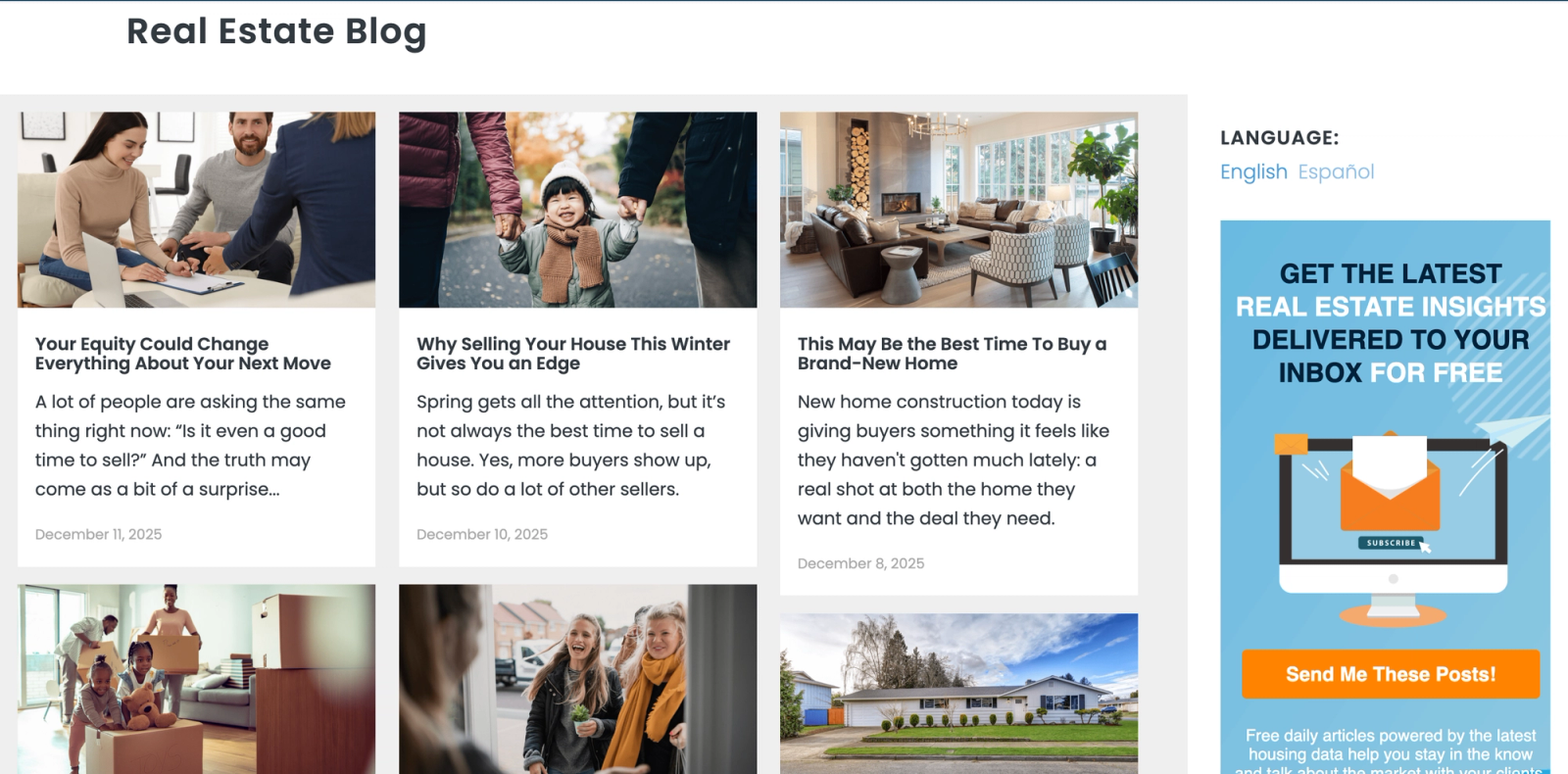
KeepingCurrentMatters
KeepingCurrentMatters targets real estate professionals with data-driven content and shareable infographics.
Their content strategy emphasizes visual information presentation. Market statistics become attractive graphics agents can share with clients. Complex concepts get broken down into simple, understandable formats.
HomeLight
HomeLight balances educational content with strategic business positioning, demonstrating how blogs can generate leads while providing genuine value.
Their comprehensive guides answer real buyer and seller questions thoroughly. But they naturally incorporate their agent matching service as the logical next step after education.
Take Your Real Estate Blog To The Next Level With Madison
You've built the traffic. Now it's time to convert those visitors into actual clients.
Most real estate blogs attract visitors but fail to capture leads because there's no immediate way for interested prospects to engage. While you're busy with showings and closings, potential clients are browsing your content and leaving without connecting.
That's where Madison's AI chatbot transforms your blog from an information resource into a lead generation machine. Madison engages visitors in real-time, answers their specific questions about your market, and captures their contact information while their interest is highest.
Related articles
More in SEO & Marketing
Keep reading in the same category to go deeper on the topics that matter to your team.
Answer engine optimization explained for real estate: how AI answers pick their sources, what to publish, what to measure, and the fair housing line to stay behind.
Generative engine optimization for real estate teams: how to get cited by ChatGPT, Gemini and AI Overviews, with a checklist and the data behind it.
About Madison
The AI assistant built for real estate lead gen
Madison is Realty AI's conversational assistant for real estate websites. It engages visitors instantly, qualifies buyers, sellers, and renters through natural dialogue, routes summaries to your CRM, and keeps your team focused on closing.
5.0 average from 2,500 customer reviews
“We captured 3 new transactions worth over $3.3 million in just a few months using Realty AI.”
Sarah Logue
Broker & Owner, Top 0.1%
“Within our first week of using Realty AI, I had an engaged seller ready on the phone. This has never happened before in 4 years.”
Mark Jensen
Owner & Broker of Record
“It feels like having a personal assistant on my website 24/7, sending me instant notifications so I never miss a potential client.”