


SEO & Marketing
Nathan SmithSep 10, 202614 min read

GEO vs SEO vs AEO for Real Estate Agents
GEO vs SEO vs AEO explained for real estate agents: which searches each one wins, what changes in your content, and where a solo agent should start.
Answer engine optimization is worth doing for a reason that sounds like an argument against it: when Google shows an AI summary, roughly 1% of readers click the source it cites. You win that citation anyway, because the buyer who never clicks still remembers who answered the question.

Optimizing for answer engines in real estate is not the job it is for a software brand. Your questions are local, your numbers go stale in weeks, and one whole category of them is governed by federal law.
It sits next to generative engine optimization for real estate, which chases the same AI systems from a different angle and shares most of its foundations.
Here's what we'll cover:
Start with what an answer engine actually does with a page, because every other decision follows from it.
AEO is optimizing to be the answer instead of a link beside it.
Success is a citation inside an AI response, not a position on a results page.
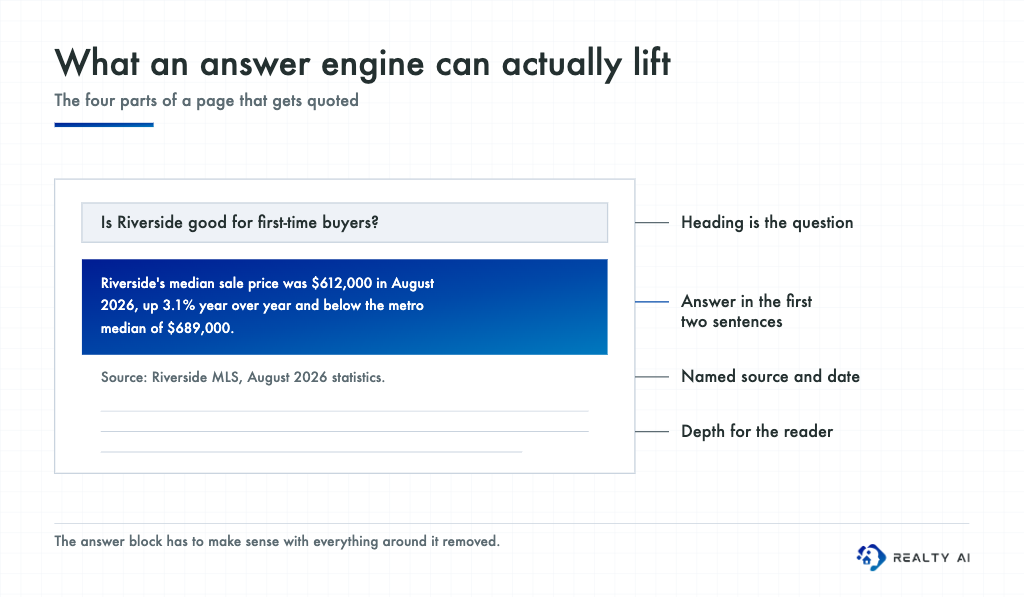
The mechanism is simple. Answer engines like ChatGPT retrieve passages that match a question's meaning, then assemble a summary crediting a few sources.
Pages that state the answer in the first two sentences under a matching heading get extracted.
The page above is the example in full: the heading is the question a buyer typed, the answer carries a median, a month, and a named MLS source, and it still makes sense lifted out of the page entirely.
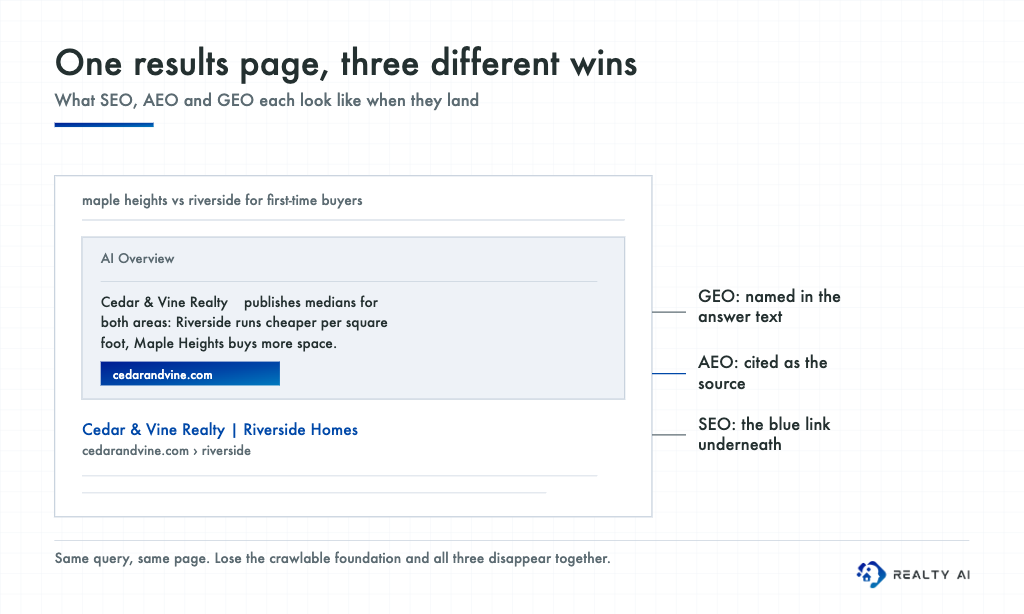
The three differ only in what counts as a win. All three fail without the same foundation.
| Column 1 | SEO | AEO | GEO |
|---|---|---|---|
| Win | Page ranks | Paragraph is quoted | Brand is named |
| Content shape | Comprehensive page | Direct question and answer | Quotable claims plus outside corroboration |
| Measured by | Rankings, sessions | Citation frequency | Share of voice in AI answers |
SEO gets the page indexed, AEO gets the paragraph extracted, GEO gets the brand remembered.
Settle the difference between GEO, SEO, and AEO for real estate agents before you promise a broker a number.
No. Answer engines find content by crawling the indexed web, so a page that cannot rank cannot be cited either.
AEO is a formatting and sourcing layer on top of SEO.
The main change is the payoff and result as citations have been decoupled from clicks so users might see you without going to your website.
Citations do not bring traffic. Plan for brand building and total visibility.
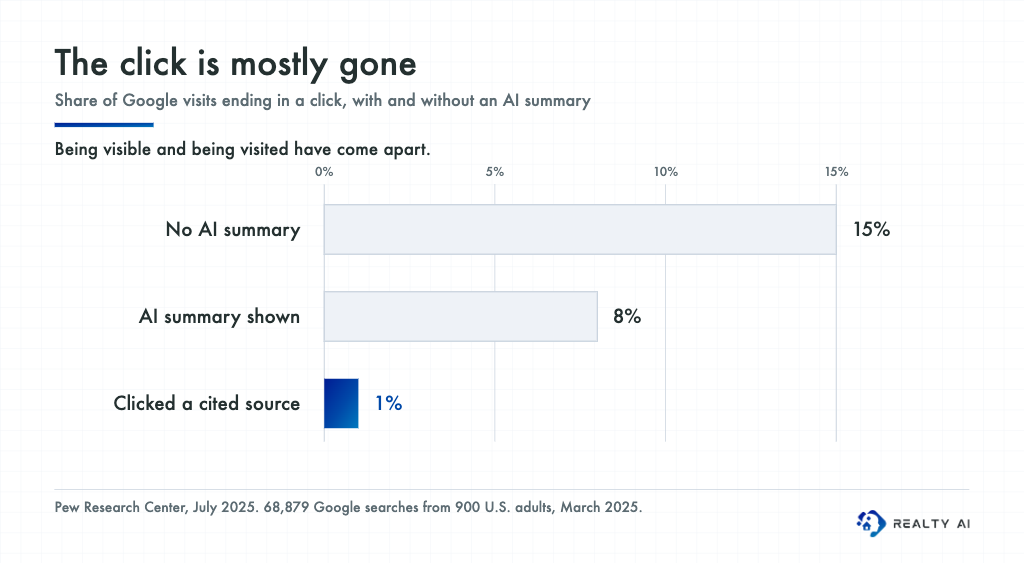
Pew tracked 68,879 Google searches across 900 U.S. adults in March 2025. With an AI summary present, users clicked a result in 8% of visits versus 15% without one, and clicked a cited source in about 1%.
Thus, a citation is not a traffic channel nor is it a replacement for a session. It has become a third-party “trusted” endorsement during a user’s moment of research.
The goal is to compound these moments to increase the number of touch points you have with a user so they eventually come to your website via a branded search.
Buyers ask specific questions and these informational questions are what trigger AI answers.
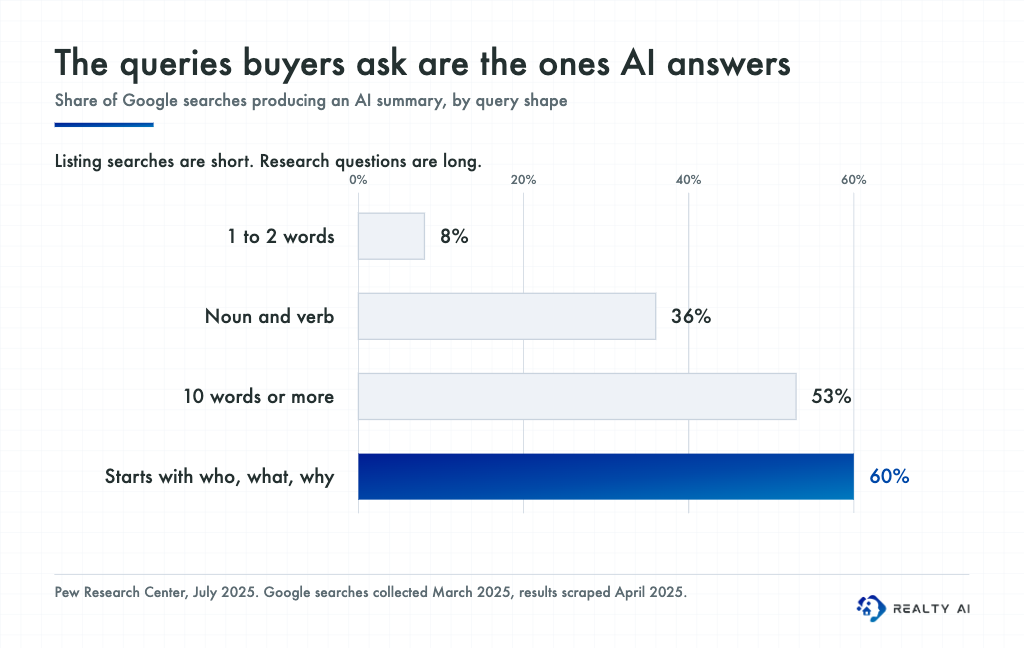
Across all searches in the same Pew dataset, 18% produced an AI summary. Question-word searches produced one 60% of the time, and searches of ten words or more 53%.
The share of AI overviews appear in search have gotten even more aggressive over time and you more than likely will see one on every search at this point.
So stop fighting it and focus on:
Answer engines look for evidence they can trust and corroborate.
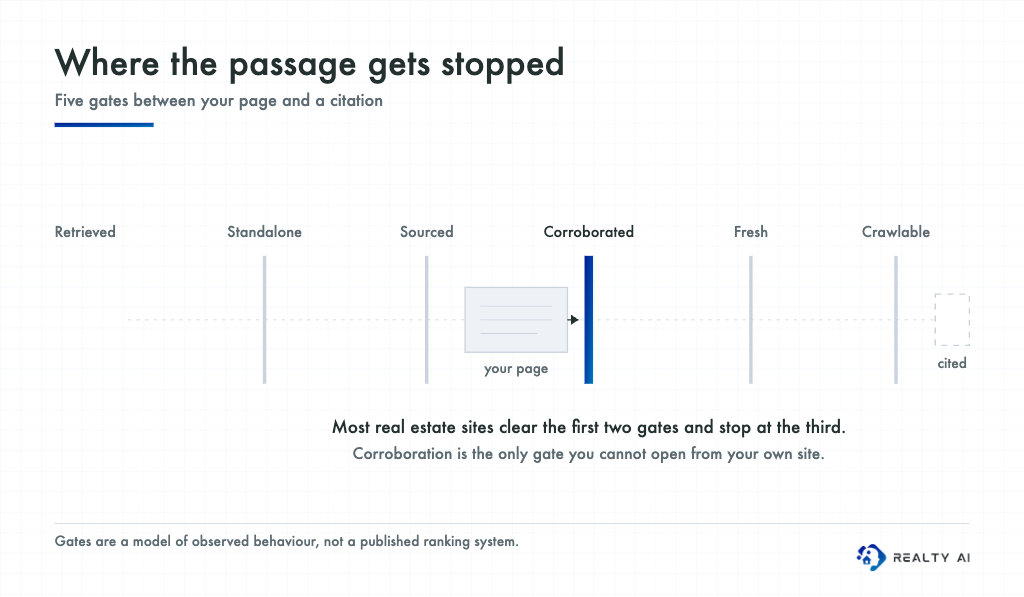
Clear answers, credible sourcing and third-party validation all increase your chances of being cited.
If three credible places say you lead a market and your site agrees, the claim gets used; if only your site says it, it reads as marketing and is ignored.
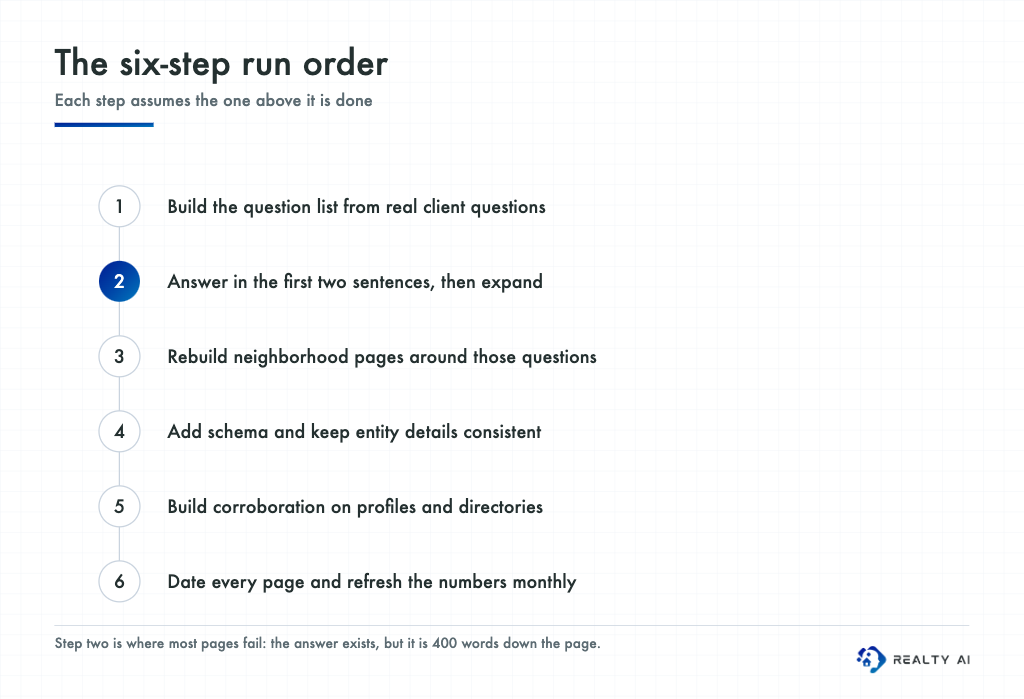
Pull them from your inbox, call notes, chat transcripts, and the People Also Ask box. Phrase each as a client would, then make it a heading.
Question-shaped long tail real estate keywords are the raw material, because they match the length and shape of queries that trigger AI answers.
It's also much easier to rank for highly specific questions as they don't get surfaced in keyword tools.
Forty to sixty words, no wind-up. Expand underneath for the human reader.
Plain text
## How long does it take to sell a house in [Market]?

Homes in [Market] sold in a median of [N] days in [Month Year],
versus [N] days a year earlier.

Detached homes took [N] days,
condos [N].

Source: [MLS board], [Month Year] statistics.

[Then: what is driving it, what it means for pricing, exceptions]Turn neighborhood pages into direct answers to the questions buyers actually ask. Support key claims with local data, credible sources and clear statistics.
You have access to the MLS, get creative with how you display the data.
The same discipline behind a high-converting MLS location page makes it legible to AI.
Article, RealEstateListing, LocalBusiness, and Person markup remove ambiguity about what the page is and who published it.
Keep name, address, and phone identical everywhere.
Your content should be clear and disambiguating enough but adding this layer is a more of a nice to have.
Profiles, association listings, review sites, and press coverage all feed the consensus check.
A complete Google Business Profile for real estate agents is the highest-leverage one because it is structured and verified.
Put a visible last-updated date on anything with numbers and refresh it regularly.
Reinforce freshness by updating statistics, replacing outdated sources, reviewing listings and local information, and removing claims that are no longer accurate.
Freshness should be visible in both the content and the evidence behind it. Being cited with stale figures is worse than not being cited.
You can publish neighborhood answers. You cannot publish neighborhood opinions.
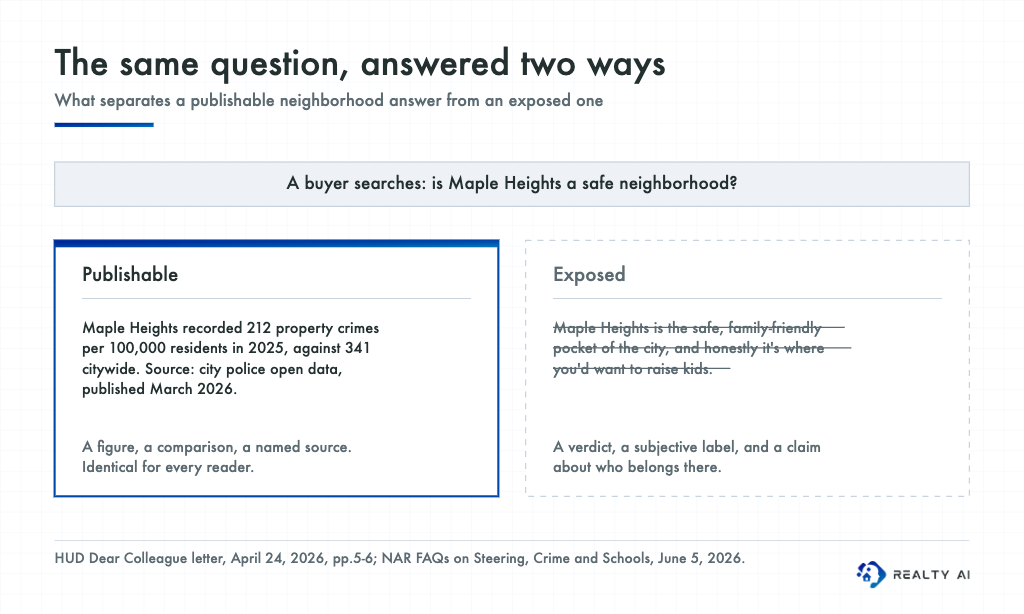
Share the same information with everyone, stay factual, and leave out opinion and hearsay.
What still exposes you is subjective framing.
Ranking areas, calling one safe or up-and-coming, or describing who would fit there moves you from reporting facts to expressing preferences about people.
The same rule binds any automated system answering on your behalf so always ensure you are reviewing your outputs.
Track whether you are being cited, whether your name is growing and ask new leads how they heard about you.
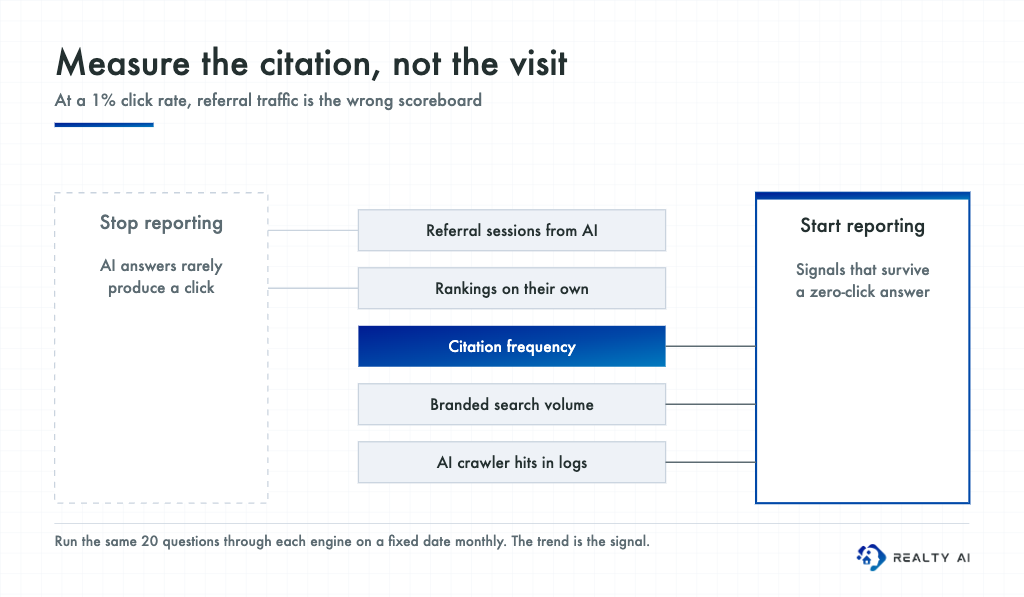
| Metric | How | Good looks like |
|---|---|---|
| Citation frequency | 20 core questions run monthly through ChatGPT, Gemini, Perplexity | Rising share of answers naming you |
| Branded search | Search Console queries containing your name | Growth uncorrelated with ad spend |
| Answer accuracy | Ask each engine to describe your business | Correct service area and contact details |
| Crawler activity | Server logs filtered for GPTBot, ClaudeBot, PerplexityBot | Regular crawls of question pages |
| Increased Leads | Ask each client how they found you | A steady increase in pipeline. |
None yet.
No established leader exists and most options are under a year old, so a spreadsheet of 20 questions checked monthly against each engine gives you most of the signal a paid tracker would.
AI prompt trackers are not consistent because AI is non deterministic, meaning that every question will have a slightly different answer. Look at it as directional data.
Spend the budget on building content that answer questions instead.
It stops in two places.
Publish sourced, dated, self-contained answers to the local questions buyers actually ask, then make sure the rest of the web agrees with you.
The click may not come, but the citation builds the trust that brings people to you by name.
Book a demo and we will show you the conversations your site is currently missing.
Related articles
Keep reading in the same category to go deeper on the topics that matter to your team.
GEO vs SEO vs AEO explained for real estate agents: which searches each one wins, what changes in your content, and where a solo agent should start.

Generative engine optimization for real estate teams: how to get cited by ChatGPT, Gemini and AI Overviews, with a checklist and the data behind it.

How to create a high-converting MLS location page: the SEO structure that ranks it, the local content that earns trust, and the features that capture leads.
About Madison
Madison is Realty AI's conversational assistant for real estate websites. It engages visitors instantly, qualifies buyers, sellers, and renters through natural dialogue, routes summaries to your CRM, and keeps your team focused on closing.
5.0 average from 2,500 customer reviews

Sarah Logue
Broker & Owner, Top 0.1%

Mark Jensen
Owner & Broker of Record

Michelle Makos
Broker & Owner
See it in action
See how Madison qualifies, books, and routes leads in 2 seconds, across every page on your site.
