GEO vs SEO vs AEO is three acronyms pointed at one website, and only one of them is new work. Here is which searches each discipline wins, and what a working real estate agent should actually do about it.
Nathan SmithPublished Sep 10, 2026Updated Sep 10, 202614 min read
Every marketing vendor now sells a different letter.
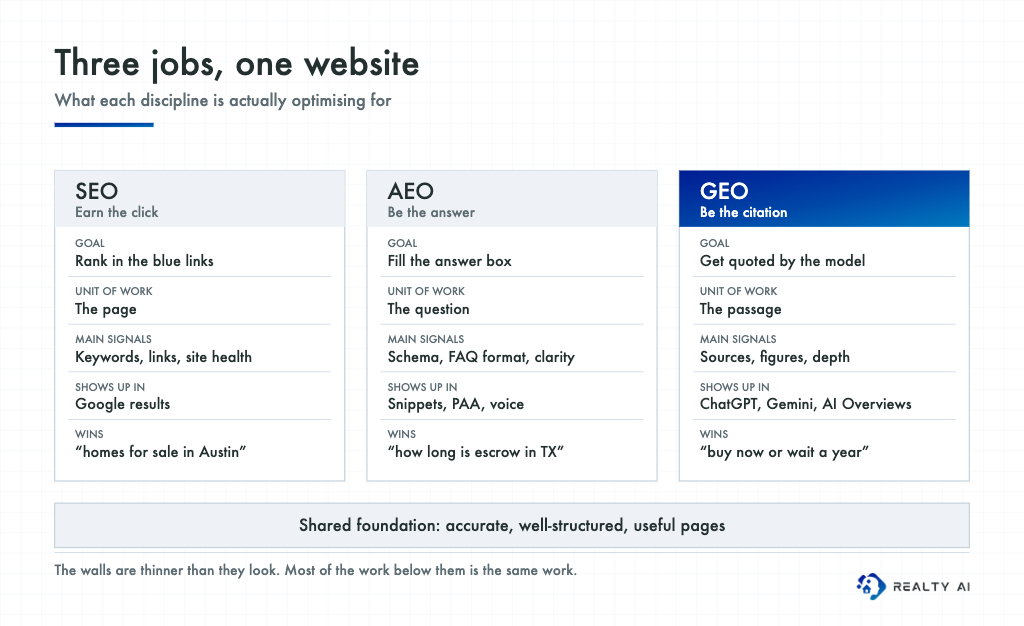
SEO gets you ranked, AEO gets you into the answer box, and GEO gets you quoted inside ChatGPT.
The three are real distinctions, not invented ones. They are also mostly the same job done to different depths, which is the part nobody selling you a package tends to lead with.
GEO vs SEO vs AEO: the short answer
SEO optimizes a page to rank.
AEO optimizes a question to be answered.
GEO optimizes a passage to be quoted.
Everything else follows from those three units.
If you are working on a page, you care about keywords, links, and site health. If you are working on a question, you care about giving one clean answer near the top.
If you are working on a passage, you care about whether a paragraph survives being lifted out of context.
What each one looks like in a real estate search
Discipline
What the buyer is doing
What you publish to win it
How you know it worked
Real estate example
SEO
Comparing options and ready to click
Listing and location pages built to rank, on a site that loads fast and gets crawled
Impressions and clicks climbing in Search Console
homes for sale in [neighborhood]
AEO
Reading the answer, often without clicking
A 40 to 80 word answer directly under a question heading, marked up as FAQ
You own the snippet, or your profile is what voice search reads out
how much are closing costs in [city]
GEO
Asking an AI who to trust
Pages carrying real figures and named sources, plus one consistent identity across the web
You get named in a prompt test, and branded search rises
best agent in [city] for first-time buyers
Time to impact differs too.
“
SEO moves in months, while AEO and GEO changes tend to surface within weeks, because answer features and models re-crawl and re-synthesize continuously rather than waiting on a ranking shift.
Notice how much of the AEO and GEO rows you already own. A well-marked-up FAQ page serves AEO, and the same page written with real numbers in it serves GEO, which is why the tactical work in generative engine optimization for real estate reads like content hygiene rather than a new department.
What each one actually is
What is Search engine optimization (SEO)?
SEO is the practice of shaping a website so search engines rank its pages highly for a given query.
It has been the default discipline since the late 1990s, and it treats the page as the unit of work: keywords, internal structure, backlinks, and technical health all serve one page's position in a list.
What is Answer engine optimization (AEO)?
AEO is the practice of formatting content so a search engine can lift a direct answer out of it and show that answer without a click.
It targets featured snippets, People Also Ask boxes, voice results, and the local pack.
What is Generative engine optimization (GEO)?
GEO is the practice of making your content likely to be quoted when a language model composes an answer.
The term was coined in a 2024 academic paper and picked up by the industry from there.
Which of your buyers' searches each one wins
AI answers do not appear evenly.
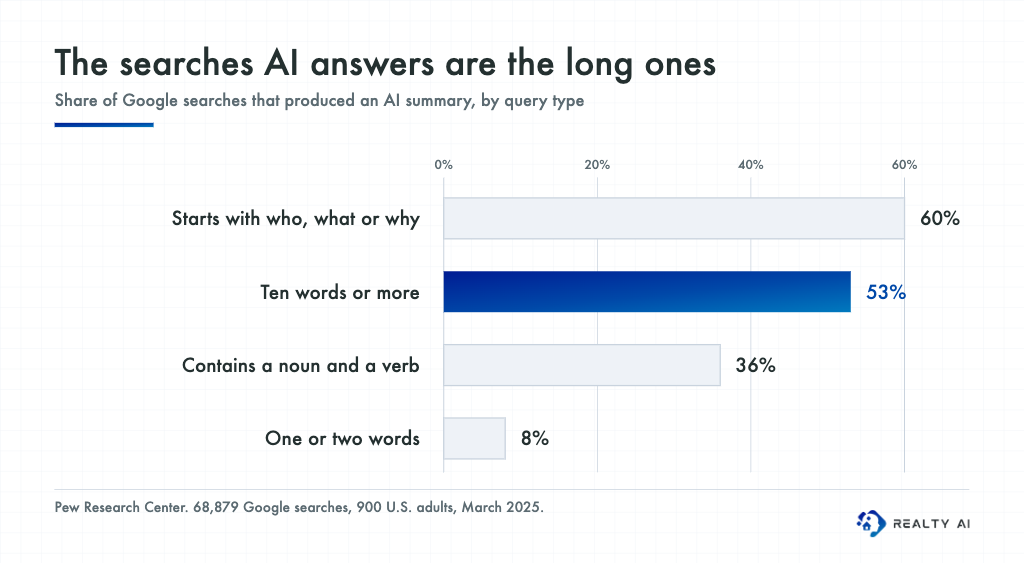
Pew Research Center tracked 68,879 Google searches from 900 U.S. adults and found that only 8% of one or two word searches produced an AI summary, while 53% of searches of ten words or more did. Searches beginning with who, what, when or why produced one 60% of the time.
Map that onto how your buyers actually type. "Austin condos under 500k" is four words and still a blue-links fight. "Should I buy in Mueller now or wait until rates drop" is thirteen words, and a machine is answering it above the fold.
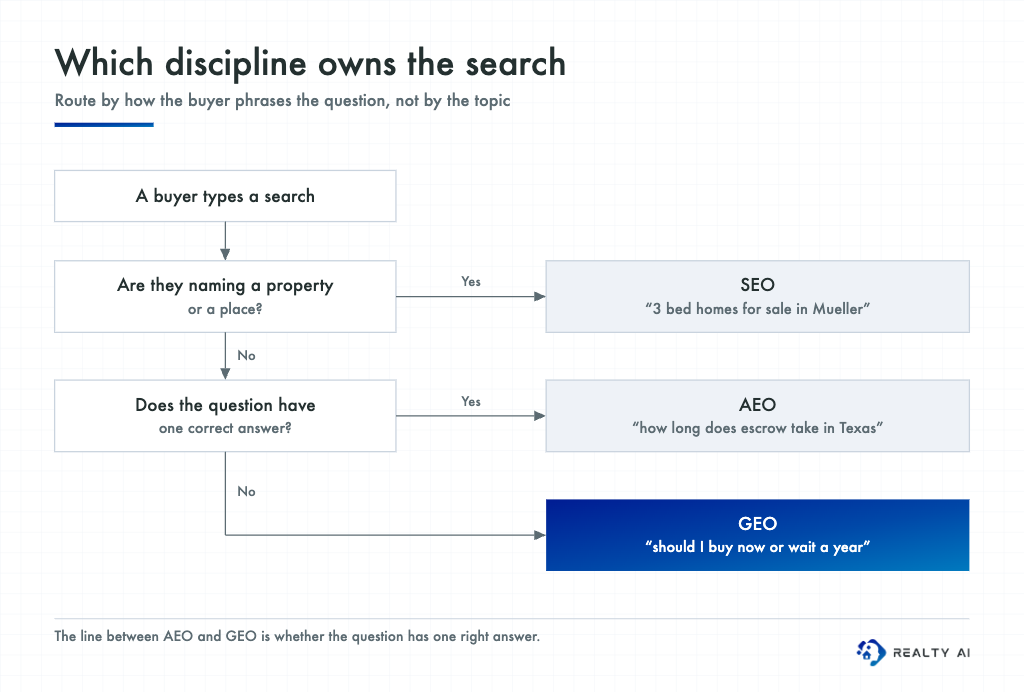
So the split is not by topic, it is by phrasing.
Your IDX and location pages still live or die on classic ranking factors, while the advisory content around them is being consumed and summarized, which is the territory covered by long tail real estate keywords.
AEO vs GEO: the test that separates them
Most explanations of AEO vs GEO stop at "one is snippets, one is AI." That does not help you decide what to write on Tuesday.
Here is a test that does.
“
Ask whether the question has one correct answer.
"How long does escrow take in Texas" has one correct answer, so it resolves into a snippet, a voice result, or a People Also Ask box. That is AEO, and it is won with structure: a direct answer in the first sentence, clean headings, and real estate schema markup telling the crawler what it is looking at.
"Should I renovate the kitchen before listing or price it as-is" has no single correct answer. It gets assembled from contractor costs, local comps, and agent opinion, and your goal is to be one of the sources in that mix. That is GEO.
For agents the AEO half also runs through the map pack, since questions like "how much do agents charge in Austin" often resolve against your profile rather than your website, which makes your Google Business Profile setup an answer-engine asset rather than just a local listing.
Why AI answers favor agents who never ranked first
Here is the finding that should change how a solo agent thinks about this.
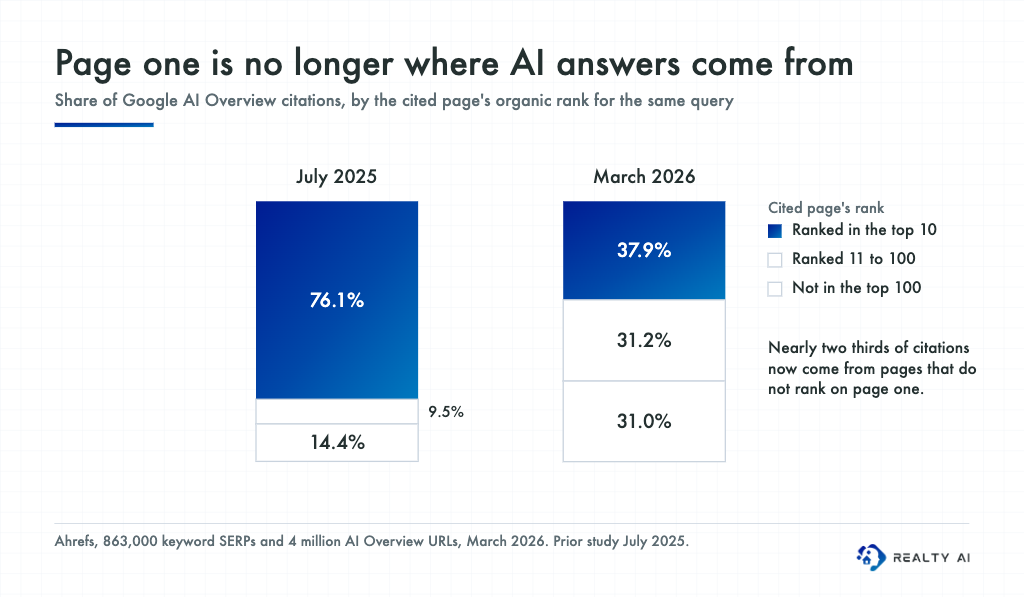
Only 37.9% of the pages cited in an AI Overview also ranked in Google's top 10 for the query being asked, down from roughly 76% eight months earlier.
The remainder split almost evenly between positions 11 to 100 and pages that do not rank in the top 100 at all.
The mechanism is query fan-out, which Google documents publicly.
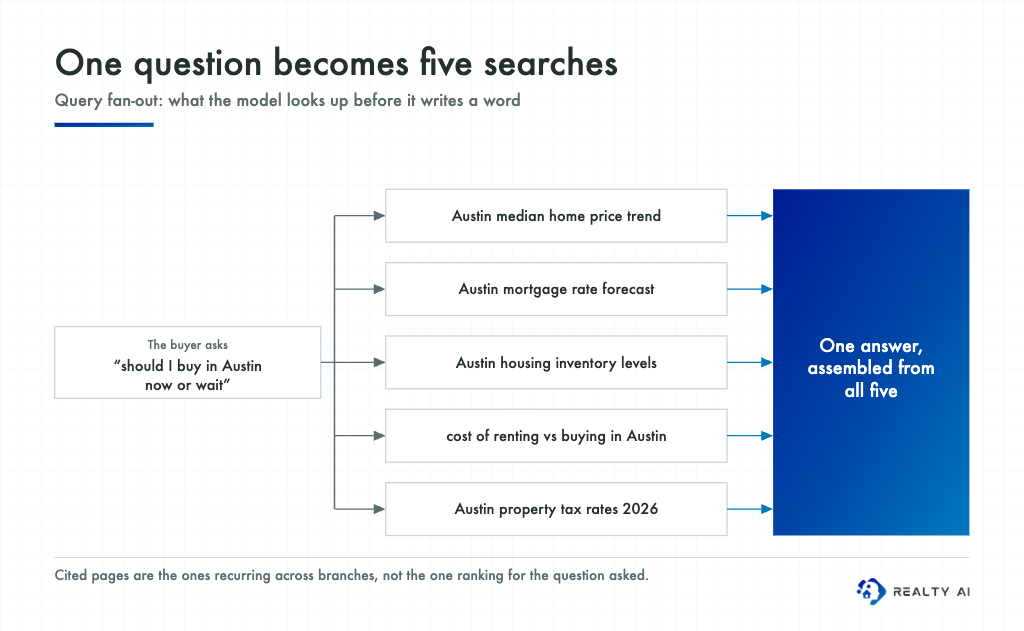
When an AI answer triggers, the original search is split into related sub-questions, and the pages cited are the ones appearing repeatedly across those sub-query results rather than the ones winning the original search.
In practice that means a buyer asking whether to buy now is never one search.
The model runs the price trend, the rate forecast, the inventory picture, the rent-versus-buy maths, and the tax rates, then writes one answer from all five, so a page covering three of those branches well beats a page that owns the headline question alone.
That is the opening for an agent who has never outranked the portals.
You are no longer fighting for one page-one slot on "homes for sale in [city]," you are competing to be the most consistently useful answer across the twenty questions surrounding that search, which is why domain authority still helps and the link-building work is not wasted.
What ignoring this actually costs you
“
The uncomfortable part is that winning here often produces less traffic, not more.
In the same Pew data, people clicked a traditional search result in 8% of visits where an AI summary appeared, against 15% where none did.
Clicks on the citation links inside the summary ran at about 1% of visits, and 26% of visits with a summary ended the browsing session outright, against 16% without.
“
That inverts what your website is for.
It used to catch a wide, mostly unqualified stream and filter it; now the filtering happens before the click, and what arrives is smaller, later-stage, and far more expensive to waste.
Which makes response time the metric that matters.
Where to start depends on what you already have
One habit is universal: answer before you explain.
Open every section with a self-contained sentence that resolves the question, then give the context underneath, because a section that spends three sentences clearing its throat cannot be quoted.
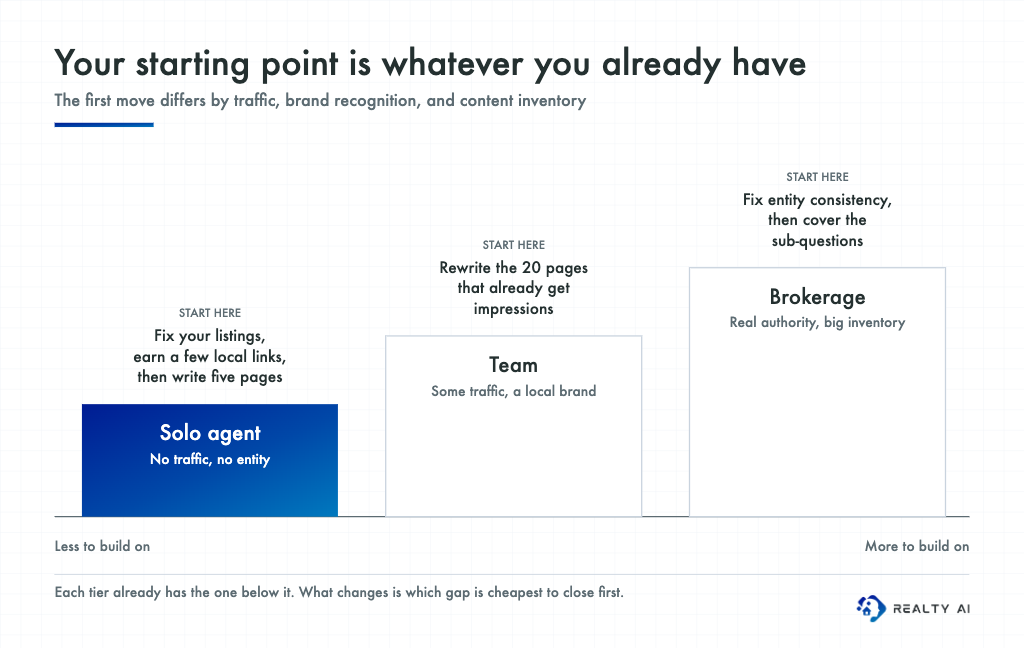
If you are a solo agent
“
You have little traffic and, more to the point, no entity.
Nothing on the open web establishes you as a distinct professional tied to a specific patch, and closing that gap is the whole job at this stage.
Local citations and links are how you close it.
Citation here means the local SEO sense, a listing of your name, address, and phone on a directory, which is a different thing from the AI citations discussed above.
Get those listings agreeing with each other and with your profile, then earn a handful of real local links from a neighborhood association, a chamber, or a sponsorship, and a model finally has corroborating sources to resolve your name against.
Content comes next, and it should be narrow.
Write five pages answering the questions your farm area actually asks, each opening with a direct answer sentence, and link them to each other so they read as one coherent patch rather than five orphans.
If you are a team
You have some traffic, a recognizable local brand, and a blog with posts already earning impressions. That inventory is your asset, and it is usually underperforming.
“
Start by rewriting, not publishing.
Pull the twenty pages already earning impressions in Search Console and rewrite each opening paragraph to answer its question in one sentence, because retrieval is already happening for those pages and the only thing between them and a citation is the shape of the prose.
If you are a brokerage
You have real domain authority, hundreds of pages, and agents publishing under your domain.
“
Your entity problem is the opposite of the solo agent's: not too little presence, but too much of it disagreeing with itself.
Two moves matter.
Fix entity consistency first, so that agent profiles, office details, and third-party mentions agree on names, titles, and areas served, because a model resolving "who sells homes in 78723" is reconciling exactly those sources.
Then build sub-question coverage, since fan-out rewards the domain appearing across twenty related searches rather than the one winning a single head term, and real estate backlinks still feed the retrieval those sub-queries run against.
What everyone should track
Four things worth checking monthly, whatever your size:
Prompt tests. Ask ten buyer questions in ChatGPT and Gemini and record whether you are named.
Branded search volume. A rising trend on your own name is often the only visible trace of an answer you were quoted in.
Direct and unattributed traffic. People who read your name in an answer tend to type it, and our analysis of what real estate website traffic actually looks like shows how much arrives with no source attached.
Referrals from AI tools. Small numbers today, but the trend line is the signal.
One compliance note. All three disciplines reward direct answers to questions like "is this a good neighborhood for a family," and that phrasing sits close to Fair Housing risk.
What not to change
The temptation is to treat this as a rebuild. It is not.
Site speed, crawlability, clean URLs, and working IDX pages remain prerequisites, because a model cannot cite a page a crawler could not read.
Map-pack and "near me" intent has not moved into AI answers either, so local search is still where a meaningful share of transaction-ready demand shows up.
Frequently asked questions
Is GEO replacing SEO?
No. AI summaries appeared on 18% of Google searches in the Pew data, which leaves the majority still resolved by traditional results, and AI answers are assembled from pages that had to be crawlable in the first place.
What is the difference between SEO and AEO?
SEO tries to earn the click by ranking a page. AEO tries to satisfy the searcher on the results page itself, through featured snippets, People Also Ask, and voice results.
Is AEO the same as GEO?
They overlap but are not identical. AEO targets structured answer features inside a search engine, while GEO targets being synthesized into an AI-written response, and the practical difference is whether the question has one right answer.
Is SEO still worth it in 2026?
Yes, particularly for listing and location searches, which are short and rarely trigger an AI summary.
The returns have shifted from advisory content toward transactional pages.
Do I need all three as a single agent?
You need one website that is fast, marked up, and written to answer questions directly. That covers most of AEO and GEO without a separate budget line for either.
Will optimizing for AI hurt my Google rankings?
Unlikely. The changes involved are textual, and they leave your domain, backlinks, and metadata untouched.
The Bottom Line
GEO vs SEO vs AEO is not three budgets, it is one website judged by three different readers: a ranking algorithm, an answer box, and a language model.
Keep the technical and local foundations, write so a paragraph can be lifted out and still be true, and the other two mostly take care of themselves.
The agents who benefit most are the ones who never outranked the portals, because inside an answer the ranking gap largely disappears.
Answer engine optimization explained for real estate: how AI answers pick their sources, what to publish, what to measure, and the fair housing line to stay behind.
How to create a high-converting MLS location page: the SEO structure that ranks it, the local content that earns trust, and the features that capture leads.
About Madison
The AI assistant built for real estate lead gen
Madison is Realty AI's conversational assistant for real estate websites. It engages visitors instantly, qualifies buyers, sellers, and renters through natural dialogue, routes summaries to your CRM, and keeps your team focused on closing.
5.0 average from 2,500 customer reviews
“We captured 3 new transactions worth over $3.3 million in just a few months using Realty AI.”
Sarah Logue
Broker & Owner, Top 0.1%
“Within our first week of using Realty AI, I had an engaged seller ready on the phone. This has never happened before in 4 years.”
Mark Jensen
Owner & Broker of Record
“It feels like having a personal assistant on my website 24/7, sending me instant notifications so I never miss a potential client.”