8 Questions About Your Real Estate Website Traffic, Answered With 72,580 Conversations
Somewhere on your website last Saturday night, a ready buyer typed a question and got silence. We timestamped 72,580 conversations across 491 real estate websites to find out how often that happens, and what it is costing you.
Nathan SmithPublished Aug 24, 2026Updated Sep 2, 20266 min read
Every brokerage has some version of this argument.
Every brokerage has some version of this argument. One side is certain the website is leaking leads overnight, the other is certain the late-night ones were never worth chasing.
Both sides are working from memory not data.
So we did. Of 72,580 conversations, 40,083 landed when the office was shut, and they were not the junk everyone assumes.
If any of these have crossed your mind, start here:
Are we really missing leads, or is that just what vendors say?
Is a 10pm inquiry worth a callback, or a waste of an agent's morning?
Is this getting worse, or has it always been this way?
Which hours would actually pay if we covered them?
Do we hire someone, or just move the roster around?
What is this worth on a site our size, not a big one?
Based on these conversations we drew 8 concrete conclusions. So without further ado lets get into it.
1. When do people actually contact us?
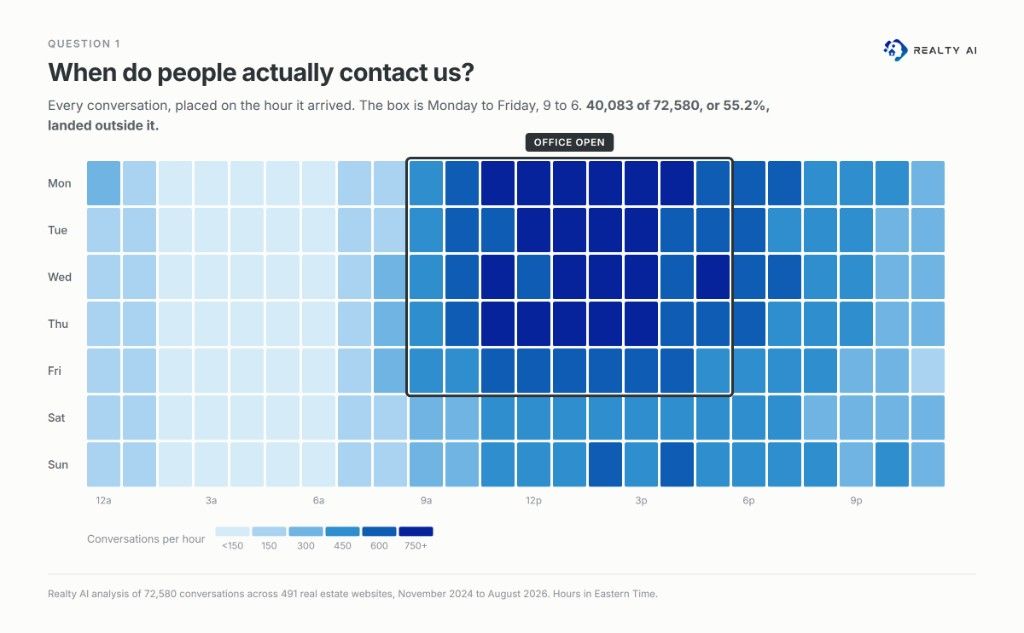
Not when the office is open. 40,083 of 72,580 conversations, or 55.2%, arrived outside Monday to Friday, 9am to 6pm.
Demand does not stop at 6pm, it drifts down slowly.
The 2pm hour is the busiest of the week. The 11pm hour still carries 2,373 conversations, which is about 45% of that peak.
And a quarter of everything lands on the weekend. That is 17,591 conversations on a Saturday or Sunday, when almost nobody is covering the phones.
2. Is this a trend we can wait out?
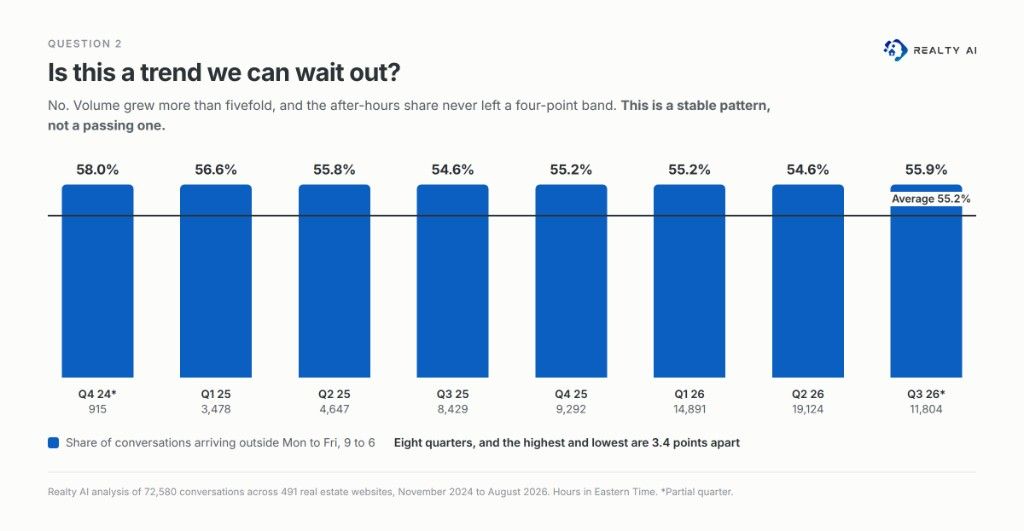
No. We split the whole period into quarters and the after-hours share never moved out of a narrow band.
The lowest quarter was 54.6% and the highest was 58.0%. Over that same stretch, total volume grew more than fivefold.
This is the least dramatic finding here and the most useful one. A stable pattern is something you can plan a schedule around, which is not true of a trend.
3. Are the after-hours ones actually worth anything?
This is the fair objection every broker raises. Late-night browsing sounds like tire-kickers.
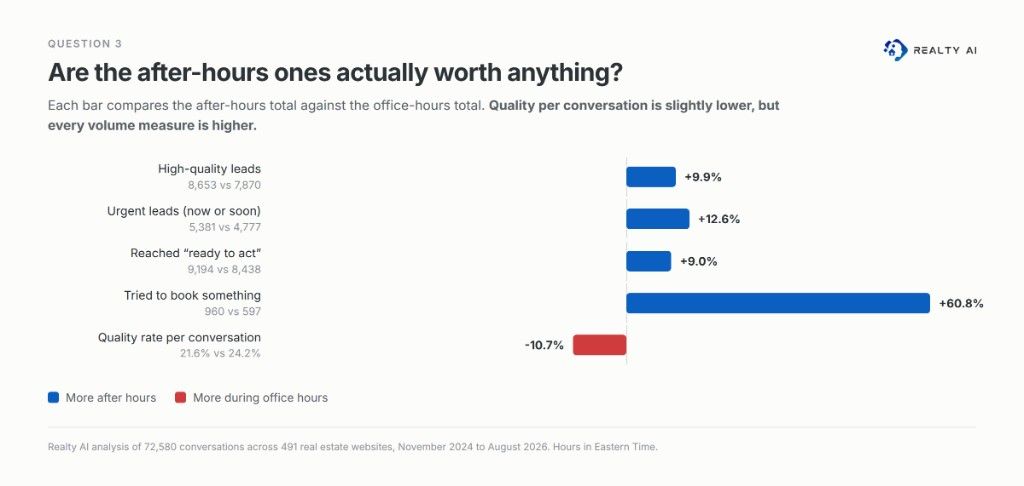
Mostly it is not. After hours produced more high-quality leads, more urgent ones, more people ready to act, and more attempts to book something.
There is one honest point against it.
Quality per conversation is a little lower after hours, 21.6% against 24.2%, so each individual chat is slightly less likely to be a good lead.
But there are far more of them, and that more than covers the difference. The hours nobody staffs produce more good leads than the hours everybody staffs.
4. Which uncovered hours are worth the most?
Not all of them equally, and this is the part that actually drives a decision.
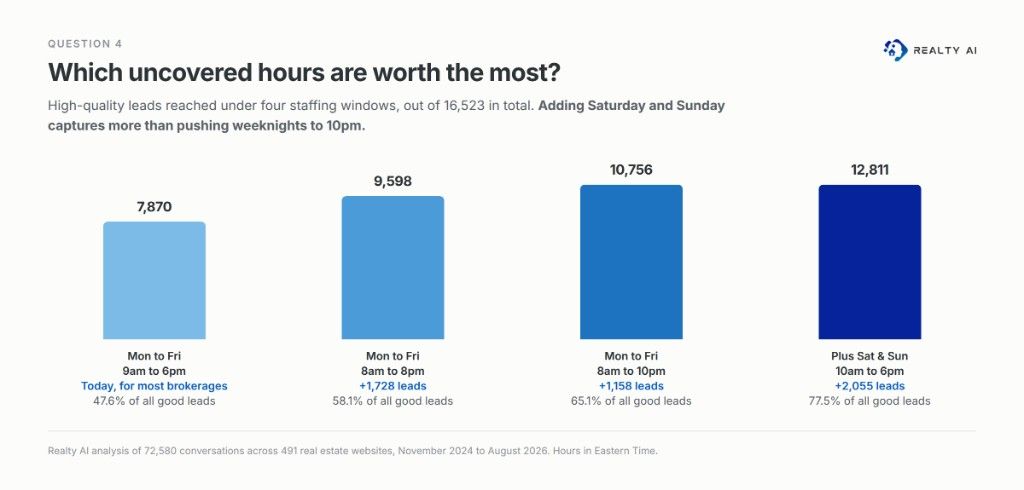
We tested four staffing windows against the full dataset. The usual 9 to 6 reaches 7,630 high-quality leads out of 16,523.
Stretching weekdays to 8am until 8pm adds 1,728 more good leads, a 22% jump. That is three extra hours a day and the cheapest win available.
Pushing on to 10pm adds another 1,158. Still worth having, but you are working harder for less.
Adding Saturday and Sunday, 10am to 6pm, brings in 2,055 more, the biggest single gain of the three. If you only do one thing, do the weekend.
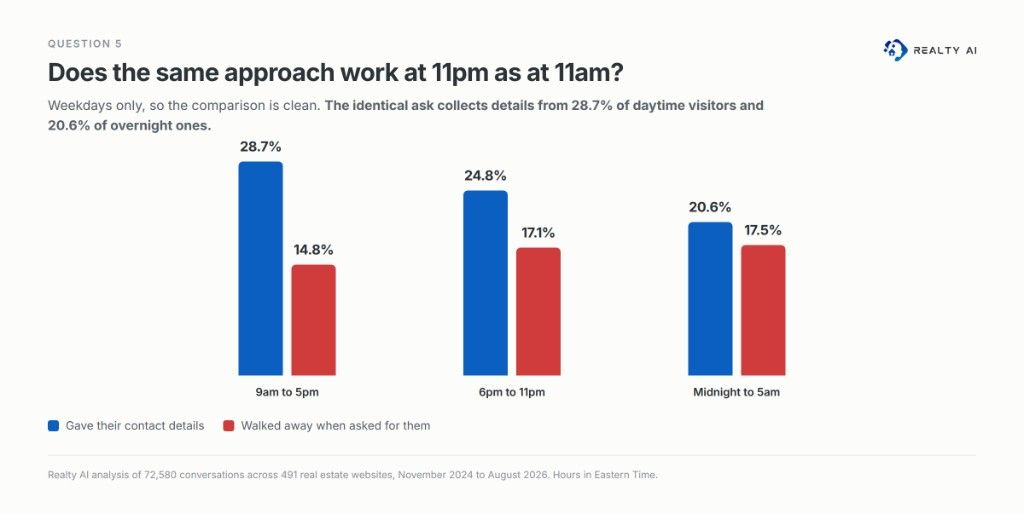
5. Does the same approach work at 11pm as at 11am?
No, and this is the finding you can act on tomorrow for free.
We looked at how often a conversation ended with contact details collected, and how often the person left the moment they were asked.
Midday on a weekday, 28.7% hand over their details. Overnight that falls to 20.6%, while walk-aways climb from 14.8% to 17.5%.
The best single hour of the week is 11am, at 30.2% captured and only 13.5% walking away.
6. How many people are actually asking for a person?
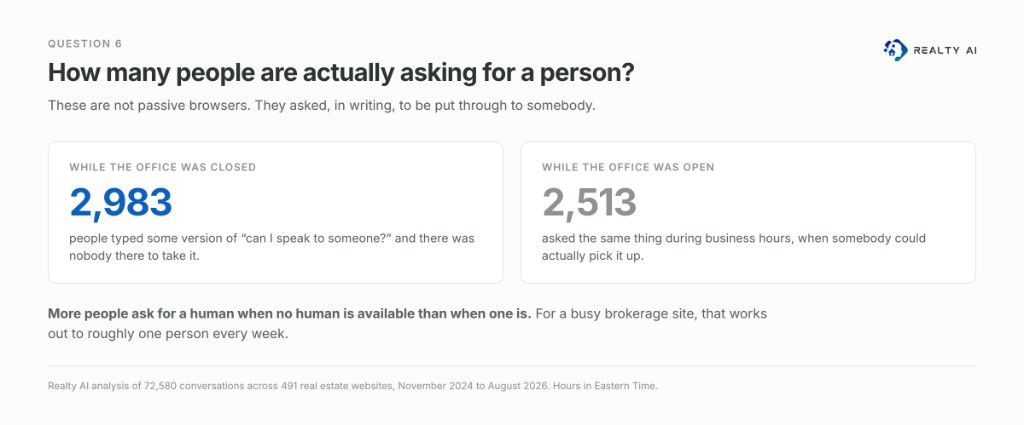
2,983 after-hours conversations ended with someone asking to speak to a realtor or a human. During office hours it was 2,513.
These are not passive browsers. They asked, in writing, and after hours there was nobody to put them through to.
More people ask for a person when no person is available than when one is. That is worth sitting with for a second.
7. What does this look like for one brokerage?
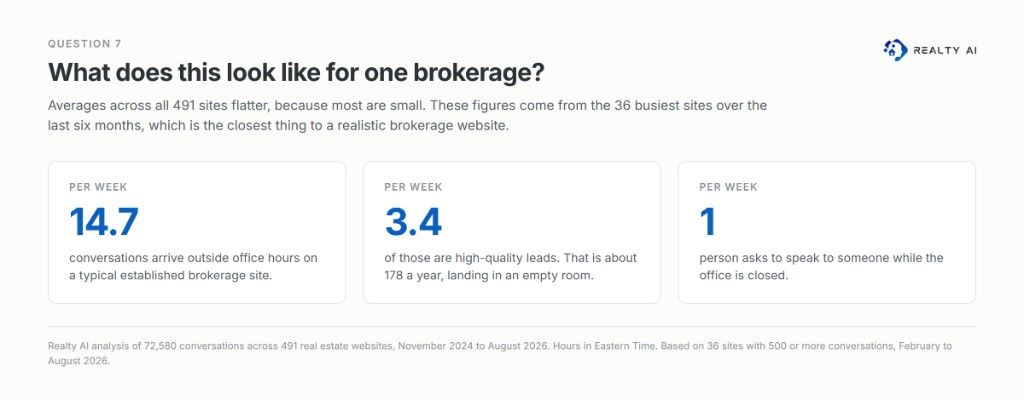
Aggregate numbers flatter, so here is the honest version. Most of the 491 sites are small, with a median of just 24 conversations over the whole period.
To get a realistic picture we took the 36 busiest sites and looked only at the last six months.
A site like that sees 14.7 conversations a week arrive outside office hours, of which 3.4 are high-quality leads. Roughly one person a week asks to speak to somebody while the office is shut.
Three and a half good leads a week is not a jaw-dropping number, and we are not going to dress it up. But it is about 178 a year walking into an empty room.
8. What is the worst-covered stretch of the week?
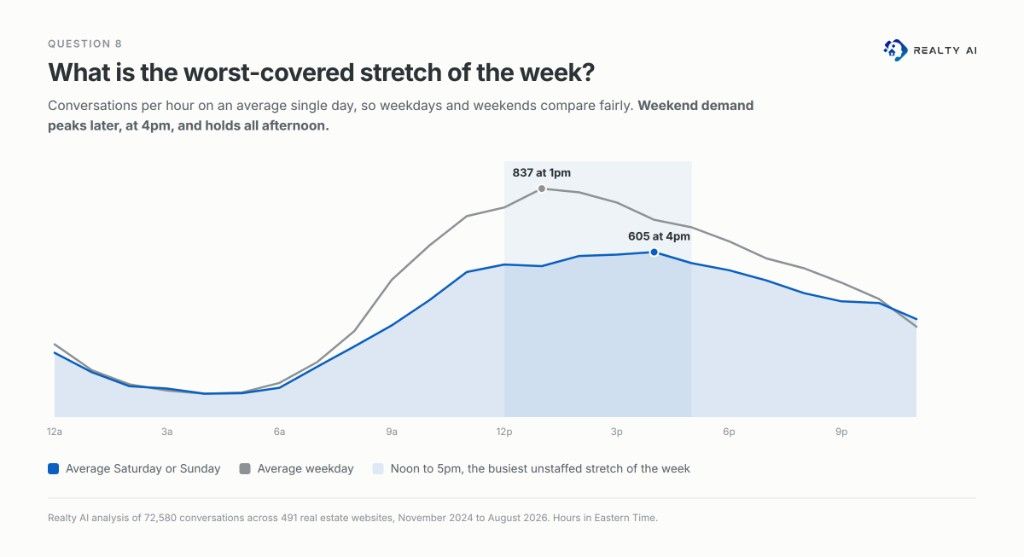
Not the quietest hour. The worst stretch is the one that combines real volume with nobody working, and that is weekend afternoons.
Weekday demand peaks at 1pm and falls away. Weekend demand peaks later, at 4pm, and holds right through the afternoon.
Between noon and 5pm on Saturday and Sunday, the busiest hours run 1,100 to 1,200 conversations. Almost no brokerage is staffed against any of it.
The overnight block gets written off completely, and it is not empty either. 14,418 conversations came in between 9pm and 6am, and 68% of them scored medium or high quality.
Four things you can do about it
1. Find out what your own quiet hours look like
Pull your last 90 days of leads and sort them by the time they came in. Count how many landed after 6pm or on a weekend.
That single number tells you whether this pattern is true for your market. Nothing here matters until you have seen your own version of it.
2. Cover Saturday before you cover anything else
The weekend is the biggest uncovered block and the easiest to schedule. One agent on a rotating Saturday shift, 10am to 6pm, beats everyone half-watching their phone all week.
If you are weighing a new hire against a rota, price both against a single extra closing. That comparison tends to settle the argument faster than any debate about coverage.
3. Work Monday's list in the right order
Everything from Friday night to Monday morning arrives as one undifferentiated pile. Most teams just work down it from the top.
Sort it instead, so the urgent ones and anyone who asked for a human go first.
Anything beats calling people back in the order they happened to arrive, and our guide to using Claude for real estate covers sorting work like this.
4. Check the maths on what you are already spending
If more than half your inquiries land when nobody is working, then more than half your lead spend is landing there too.
That is true whether you buy portal leads, run ads, or rely on your website.
Before you spend more on getting leads, work out what it costs to answer the ones you already have. It is usually the cheaper of the two.
What this data cannot tell you
We should be straight about the limits.
We did not measure how fast agents replied. This data records when people arrived, not when someone got back to them. It shows a coverage gap, which is what causes a slow response rather than proof of one.
Hours are Eastern. Visitor time zone is not recorded, so a 9pm conversation here may have been 6pm in California. That shifts individual chats but does not touch the weekend finding at all.
"Office hours" is our definition, Monday to Friday 9am to 6pm. If you already staff evenings, your gap is smaller.
Quality and urgency are scored by model at the time of the conversation, on the same rubric throughout. They are a good read on intent, not a record of what closed.
The short version
Most of your website traffic arrives when your office is closed. Those conversations are worth nearly as much as daytime ones, and there are more of them.
The gap is not a lead generation problem, it is an availability problem. And availability is a lot cheaper to fix.
Want to know what your own quiet hours are costing you?Book a demo and we will run this analysis against your site.
Related articles
More in Thought Leadership
Keep reading in the same category to go deeper on the topics that matter to your team.
The best time to sell a house in Canada is spring, but October is a close second. See what 2025 sales and 31,000 buyer conversations reveal about fall.
Most housing market indicators report deals after they happen. See what 31,000 Canadian buyer conversations showed about 2025 demand before the data did.
Rental leads convert at 49.4% vs 23.9% for buyers across 74,835 conversations. Here is the timeline data, the GCI math, and where the case breaks.
About Madison
The AI assistant built for real estate lead gen
Madison is Realty AI's conversational assistant for real estate websites. It engages visitors instantly, qualifies buyers, sellers, and renters through natural dialogue, routes summaries to your CRM, and keeps your team focused on closing.
5.0 average from 2,500 customer reviews
“We captured 3 new transactions worth over $3.3 million in just a few months using Realty AI.”
Sarah Logue
Broker & Owner, Top 0.1%
“Within our first week of using Realty AI, I had an engaged seller ready on the phone. This has never happened before in 4 years.”
Mark Jensen
Owner & Broker of Record
“It feels like having a personal assistant on my website 24/7, sending me instant notifications so I never miss a potential client.”