Best Time to Sell a House in Canada: Spring Has the Most Buyers, Fall Has the Most Decisive Ones
The best time to sell a house in Canada is spring, from April to June, with a second window that peaks in October. Our analysis of 31,000 buyer conversations adds a twist: the buyers active in the fall are the most ready to act all year.
NNathan SmithPublished Sep 10, 2026Updated Sep 10, 20269 min read
Every seasonal selling guide says spring wins, and on volume alone that's right. But volume only counts buyers, not how ready they are, and that second number changes how sellers and agents should treat the fall.
Here's what we'll cover:
The buyer data comes from a real estate AI chatbot, which answered visitor questions on Canadian agent and brokerage websites throughout 2025.
Let's get started.
The Best Time to Sell a House in Canada, Quarter by Quarter
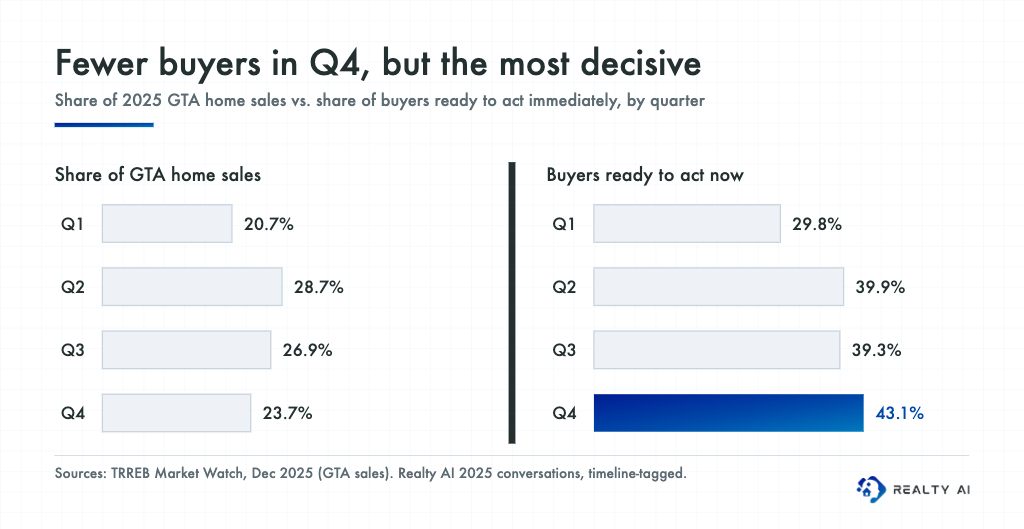
Spring (Q2) brings the most buyers, and fall (Q4) brings the most decisive ones.
Here's how 2025 looked on both measures.
Quarter
Share of 2025 GTA home sales
Buyers ready to act immediately
What it means for sellers
Q1 (Jan to Mar)
20.7%
29.8%
Slowest and least urgent
Q2 (Apr to Jun)
28.7%
39.9%
Peak volume and strong urgency
Q3 (Jul to Sep)
26.9%
39.3%
Strong, with an August dip
Q4 (Oct to Dec)
23.7%
43.1%
Fewer buyers, most decisive
The sales figures come from the Toronto Regional Real Estate Board's monthly counts, the largest market in the country. The urgency figures come from buyer conversations across Canada, so read the two columns as separate lenses on the same year.
“
Spring (Q2) brings the most buyers, and fall (Q4) brings the most decisive ones.
Spring has more buyers and more homes at the same time, and that combination lifts both sales and prices. In the GTA, May 2025 was the busiest month of the year at 6,197 sales, and it also posted the highest average price at $1,120,711.
December sat at the other end. It recorded 3,697 sales and an average price of $1,006,735, the lowest on both counts.
Economists call this the thick-market effect. When more buyers and more homes are in the market together, buyers find better matches and will pay more for them.
In U.S. data from 1991 to 2012, the gap between hot-season and cold-season annualized growth was about 146% for transactions and more than 4.6% for prices.
The study used repeat-sale indexes, so the price gap isn't just different kinds of homes selling in different seasons.
Monthly average prices in the GTA do mix in the type of home selling each month. Treat the May versus December gap as directional, not as a guaranteed spring premium.
Why October Is the Second Season
In the GTA, October was the third-busiest month of the year in both 2024 and 2025. Only two spring months outsold it each year.
October 2025 sales ran 18% above August, and October 2024 ran 33% above it. The pattern is the same both years: a summer lull, then a sharp return before the market goes quiet in December.
The usual explanation holds up. Buyers who missed out in spring come back, and many want to move before winter or the holidays.
Nationally, the fall of 2025 also showed how much sellers will do to close before year-end. CREA reported price concessions in November as buyers and sellers worked to get deals done.
Why Fall Buyers Are the Most Decisive
The share of buyers ready to act immediately hit 43.1% in Q4 2025, the highest of any quarter.
Q4 also had fewer total sales than spring or summer, so the market got smaller and more serious at the same time.
The middle of the market is what shrank. Buyers planning to move "soon" fell from 53.4% of conversations in Q1 to 41.5% in Q4.
At the same time, long-range planners ticked up from 12.4% in Q3 to 15.4% in Q4. Fall buyers split into two groups: people who need to move now, and people already planning for spring.
“
Fall buyers split into two groups: people who need to move now, and people already planning for spring.
Two caveats keep this honest. The urgency figures include some rental inquiries, and a rising share of urgent buyers is not the same as a rising number of them.
What This Means If You're Selling This Fall
Fall suits sellers who are ready to price for the market and respond quickly. You'll likely see fewer showings than in May, but a larger share of them come from people who need to buy.
Agents can use the quarter-by-quarter table above when getting more listings from sellers who assume they have to wait for spring.
List by early October. That puts your home in front of the second peak rather than the December slowdown.
Expect fewer, stronger showings. A quieter week isn't a bad sign if the buyers who do come have a clear timeline.
Price for the buyers in front of you. Fall buyers are motivated, but 2025 showed they also negotiate.
Weigh your own timeline first. A job move, a school year, or a closing date on your next home matters more than the calendar.
This isn't financial advice. Talk with your agent about local conditions, since seasonal patterns differ between cities and property types.
Why Speed Matters More in Q4
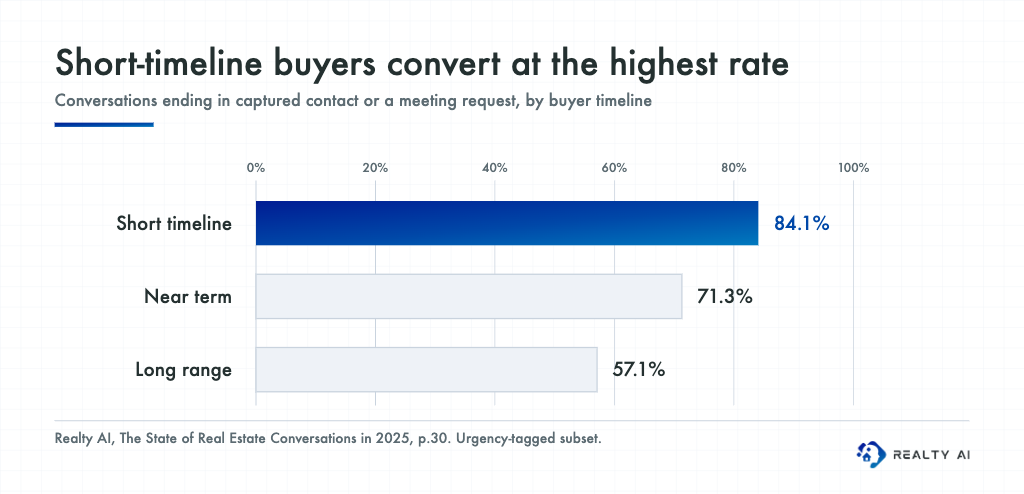
Buyers with short timelines convert at the highest rate, and Q4 has the largest share of them. In our 2025 data, 84.1% of short-timeline conversations ended with a captured contact or a meeting request.
That compares with 71.3% for near-term buyers and 57.1% for long-range planners. These rates cover website conversations, not closed sales, but they show where a quick answer pays off.
The thick-market logic works in reverse in the fall. With fewer buyers around, each serious one is harder to replace, so a slow reply costs more than it does in May.
Response time is the easiest lever to pull.
A Fall Calendar for Agents
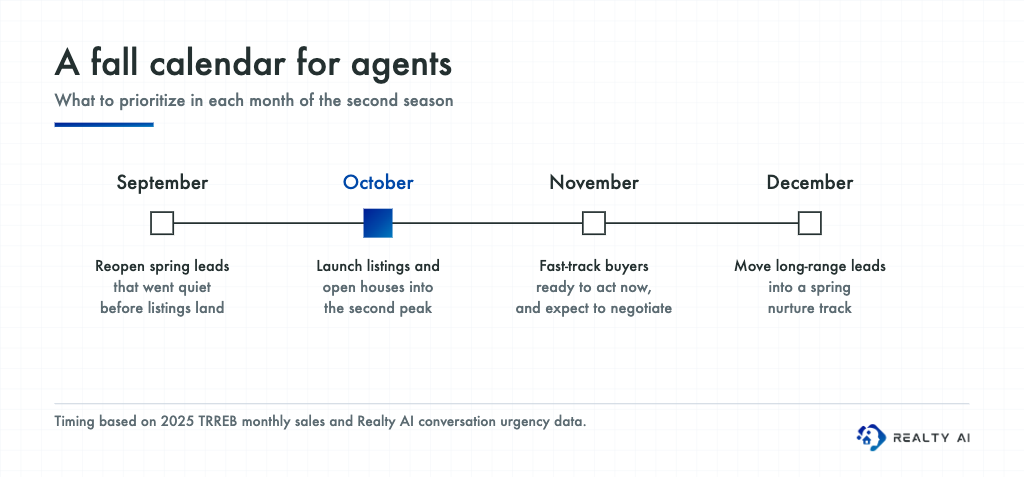
Treat September to December as its own season, with a different job each month. The calendar follows the 2025 pattern: a September build, an October peak, and a split between urgent and long-range buyers by December.
September: reopen spring leads. Buyers who went quiet in spring are a natural first call when the second season starts, and a chatbot that can follow up with old leads does the first pass for you.
October: launch listings into the peak. Time new listings and open houses for the month only two spring months outsold.
November: fast-track ready buyers. Route short-timeline leads to same-day callbacks, and prepare sellers for negotiation.
December: seed the spring pipeline. Move long-range planners into a monthly nurture track instead of pushing them to act.
For that last step, a steady cadence of real estate email marketing keeps long-range planners warm without pressuring them. Those leads are your March and April appointments.
FAQ
Which month is the best to sell a house?
In the GTA, May was the best month in 2025, with the most sales and the highest average price. April to June is the strongest window nationally, and October is the best month outside spring.
What is the hardest month to sell a house?
December is usually the hardest. In the GTA it was the slowest month in both 2024 and 2025, with 4,056 and 3,697 sales.
What month are house prices the highest?
GTA average prices peaked in May in both 2024 and 2025. Averages reflect the mix of homes selling each month, so a single month's figure isn't a precise price guide.
What month is the cheapest to buy a house?
GTA average prices were lowest in January 2024 and December 2025. Winter buyers face fewer competing offers, but also fewer homes to choose from.
Is it better to sell in the fall or wait for spring?
Spring brings more buyers, but also more competing listings. Fall has fewer buyers, and a larger share of them are ready to act, so the right choice depends on your price, your property, and your timeline.
The Bottom Line
Spring is still the best time to sell a house in Canada on volume, but October is a real second season with the most decisive buyers of the year. Sellers who list early in the fall, and agents who respond fast, get the most out of it.
To see how many ready-to-act buyers are already on your website this fall, book a Realty AI demo.
Related articles
More in Thought Leadership
Keep reading in the same category to go deeper on the topics that matter to your team.
Most housing market indicators report deals after they happen. See what 31,000 Canadian buyer conversations showed about 2025 demand before the data did.
More than half of real estate website contacts arrive when the office is closed. We analyzed 72,580 conversations across 491 sites to find out when, and what it costs.
About Madison
The AI assistant built for real estate lead gen
Madison is Realty AI's conversational assistant for real estate websites. It engages visitors instantly, qualifies buyers, sellers, and renters through natural dialogue, routes summaries to your CRM, and keeps your team focused on closing.
5.0 average from 2,500 customer reviews
“We captured 3 new transactions worth over $3.3 million in just a few months using Realty AI.”
Sarah Logue
Broker & Owner, Top 0.1%
“Within our first week of using Realty AI, I had an engaged seller ready on the phone. This has never happened before in 4 years.”
Mark Jensen
Owner & Broker of Record
“It feels like having a personal assistant on my website 24/7, sending me instant notifications so I never miss a potential client.”