Rental Leads Are the Most Ignored Segment in Real Estate, and the Data Says That Is a Mistake
Rental leads hand over their contact information at nearly twice the rate of buyers, and they tell you their move date up front. Almost no agent works them, and that is the opportunity.
Most agents treat renter inquiries as noise to be filtered out on the way to the "real" leads. That instinct is built on commission size alone, and commission size is only one input in a business that runs on time.
We analyzed 74,835 conversations across buyer, seller, and renter leads on real estate websites to see how each segment actually behaves before an agent ever picks up the phone.
Here's what we'll cover:
One note on where the numbers come from: this is behavioral data from conversations happening on agent and brokerage websites, captured by a real estate chatbot sitting on traffic those sites already had. Let's get started.
What the Data Actually Shows
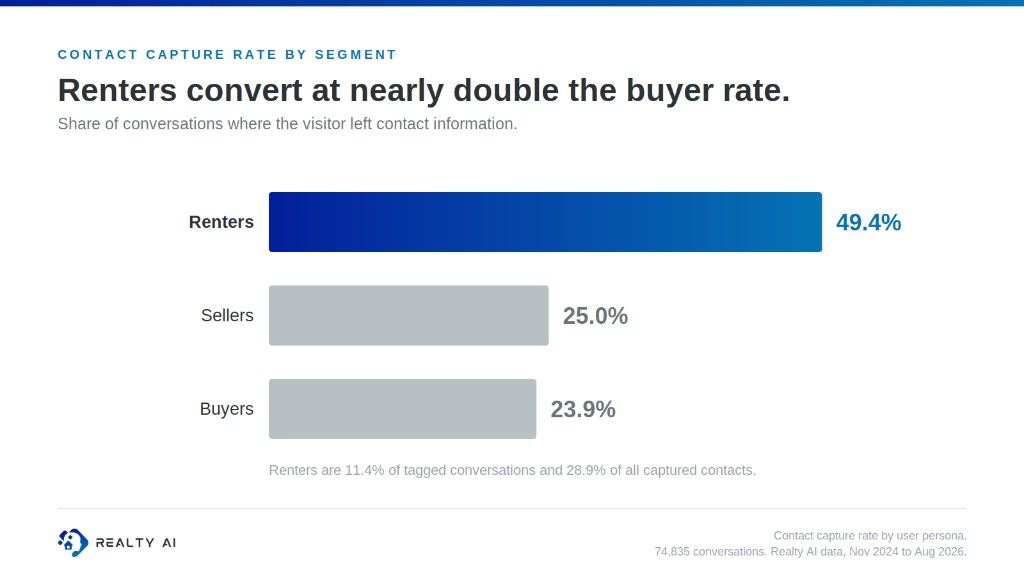
Renters give up contact information at roughly double the buyer rate. Sellers sit just above buyers, and well below renters.
Segment
Conversations
Contact captured
Capture rate
Prospective renters
8,525
4,212
49.4%
Prospective sellers
9,487
2,375
25.0%
Prospective buyers
33,474
8,006
23.9%
The volume asymmetry matters as much as the rate. Buyers generate four times the conversations and less than twice the captured contacts.
Put differently, renters are 11.4% of the tagged conversations and 28.9% of the captured contact records. That is a segment doing far more work than its traffic share suggests.
The Gap Is Not Just Motivation
The obvious objection is that renters simply arrive more motivated, so the comparison is unfair. That objection is partly correct and still does not explain the gap.
Renters do skew further along. 39.8% are tagged ready to act, against 23.1% of buyers, and 39.6% reach high engagement against 18.9% of buyers.
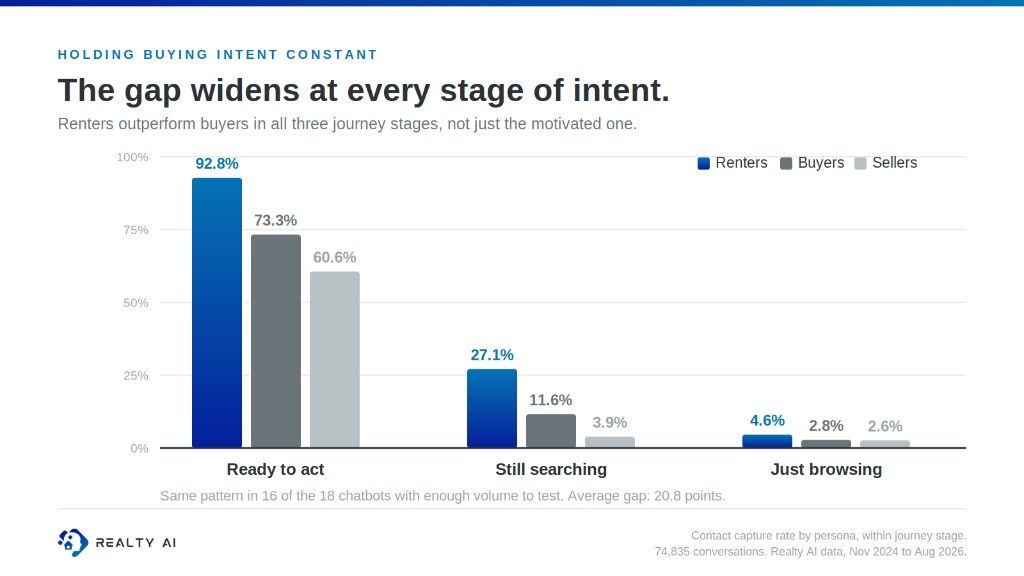
But when you hold the journey stage constant, the gap widens rather than closing.
Journey stage
Renters
Buyers
Sellers
Ready to act
92.8%
73.3%
60.6%
Still searching
27.1%
11.6%
3.9%
Just browsing
4.6%
2.8%
2.6%
Renters outperform buyers in every stratum tested, including within the same urgency band and the same engagement tier. Among conversations tagged immediate, renters still convert at 85.9% against 76.5% for buyers.
It is also not one unusual website skewing the average. Of the 18 chatbots with at least 100 conversations from each segment, 16 show the renter advantage, at an average gap of 20.8 percentage points.
The Real Advantage Is the Deadline
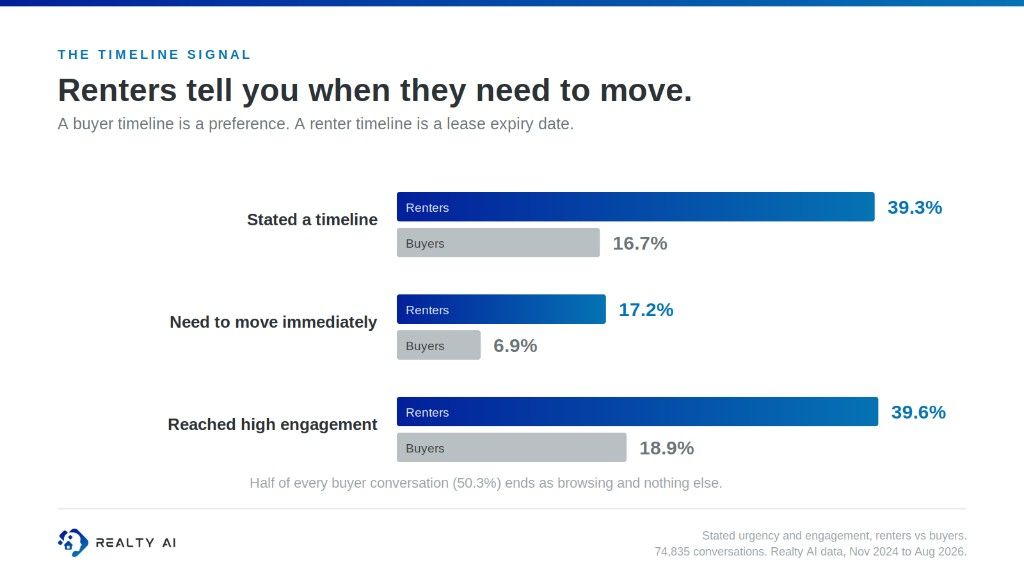
The capture rate is the headline number, but the operationally useful finding is the timeline. Renters tell you when they need to move, and buyers mostly do not.
Signal
Renters
Buyers
Stated a timeline
39.3%
16.7%
Need to move immediately
17.2%
6.9%
Ended as browsing only
33.2%
50.3%
A buyer's timeline is a preference that moves with the market, their rate lock, and their spouse. A renter's timeline is a lease expiry date printed on a document.
“
That distinction is the whole argument. It means renter pipeline is forecastable in a way buyer pipeline is not, and forecastable pipeline is what makes a process worth building.
Half of every buyer conversation ends as browsing and nothing else. Buyers treat an agent website like a listings feed, which is exactly what most agent websites are built to be.
The Commission Math Everyone Stops Halfway Through
The objection to rental leads is real and it is arithmetic. Half a month's rent at $2,500 is $1,250, while a $500,000 sale at 2.5% is $12,500.
One transaction against ten. Most agents stop the calculation there, which is the error.
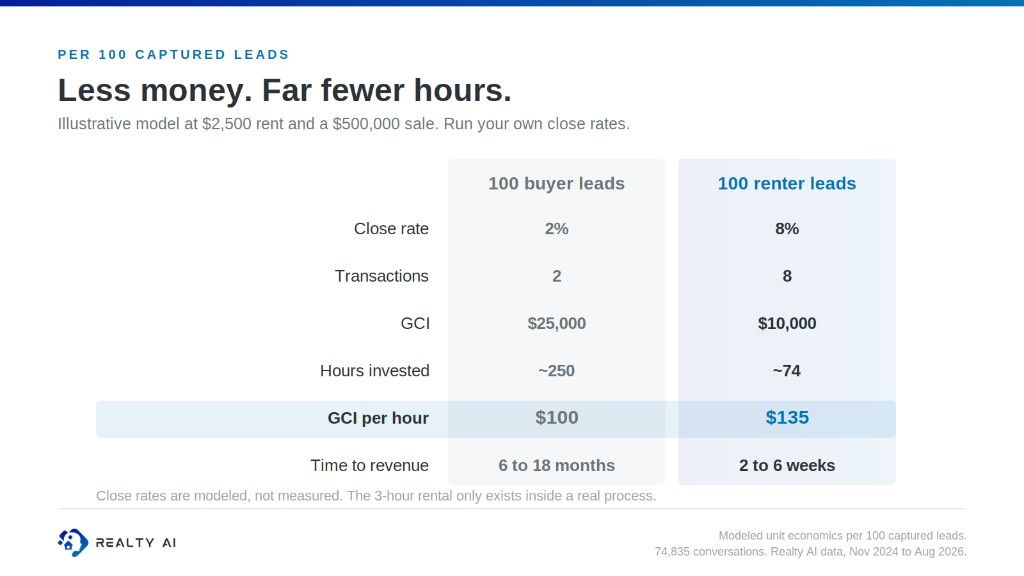
Run it per 100 captured leads and add the hours:
Column 1
100 buyer leads
100 renter leads
Close rate
2%
8%
Transactions
2
8
GCI
$25,000
$10,000
Hours invested
~250
~74
GCI per hour
$100
$135
Time to revenue
6 to 18 months
2 to 6 weeks
The renter side earns 40% of the money in under a third of the time. It also pays inside the same quarter it was worked, which changes what an agent can do with it.
The hours estimate assumes a real process: 30 minutes qualifying per lead, and roughly 3 hours per transaction with grouped showings and e-signed leases. Treat these as illustrative rather than as your numbers, and rerun them against your own close rates and average rent before making any business decision on them.
Where This Argument Breaks
Thought leadership that only presents its strong side is marketing. Here are the three places this case is genuinely vulnerable.
The close rates are assumptions, not measurements.
The conversation data captures contact capture, not signed deals. An 8% renter close and a 2% buyer close are reasonable industry figures, but move either by two points and the per-hour advantage disappears entirely.
The 3-hour transaction only exists inside a system.
Worked ad hoc, one renter at a time with individual showings, a rental takes 6 to 8 hours and the economics invert completely. The systemization is the argument, not a footnote to it.
Rental commission structures vary widely by market.
Half a month is common in some regions and unheard of in others, and in some markets the landlord pays nothing at all.
If those three things do not hold in your market, the money case fails. The timeline and capture data still stand, because those are measured rather than modeled.
The Seller Contrast Nobody Talks About
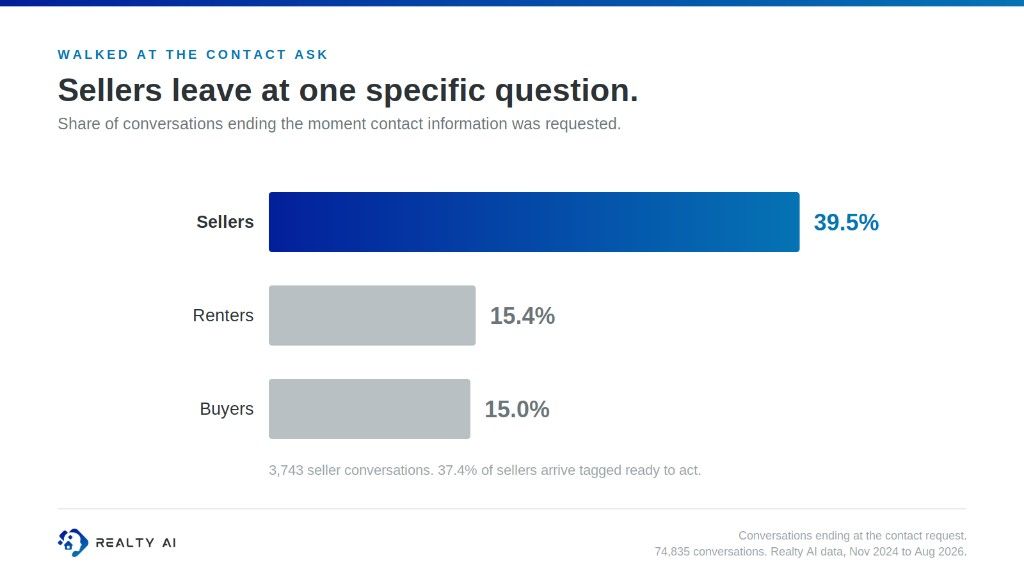
While renters are being ignored for converting too cheaply, sellers are being chased despite refusing to identify themselves. 3,743 seller conversations ended at the exact moment contact information was requested.
That is 39.5% of every seller conversation, against 15.0% for buyers. Sellers are not hard to reach because they are absent, since 37.4% arrive tagged ready to act.
They engage, they ask real questions, and then they decline to say who they are. The seller funnel does not have an awareness problem, it has a trust problem at one specific question, and understanding why website visitors abandon lead capture forms is worth more to most agents than another round of seller farming postcards.
How to Systematize Rental Leads
The process is what makes the math work, so it needs to be built before the leads arrive rather than after.
Qualify once, in writing.
A single intake capturing budget, move date, unit size, and pet situation removes almost all of the back and forth that makes rentals feel expensive.
Group your showings.
Book one afternoon a week and route every active renter into it. Four applicants across three units in one block is the difference between 3 hours per deal and 8.
Template the paperwork.
Lease, application, and reference request as e-signed templates. This is the single largest hour saving available.
Route by deadline, not by arrival.
The 17.2% who need to move immediately get called the same day. Everyone else enters a weekly cadence.
Log the lease end date.
This is the step nearly everyone skips and it is the one that compounds.
The Part That Actually Compounds
A closed rental is not a $1,250 transaction. It is a $1,250 transaction attached to a person with a renewal date twelve months out and a plausible purchase inside three years.
Eight renter deals a year is eight annual renewal conversations and a buyer list you did not pay a portal for. Compare that to a buyer lead list assembled at cost per lead from a paid channel every single month.
The renter segment is the only place in residential real estate where the acquisition cost is near zero, the deadline is documented, and nobody else is bidding against you.
Frequently Asked Questions
Are rental leads worth it for real estate agents?
On a per-transaction basis they pay a fraction of a sale, but they close faster, require fewer hours, and convert at higher rates. Whether they are worth it depends entirely on whether you have a repeatable process, because worked ad hoc they lose money.
What is the average commission on a rental?
It varies significantly by market, commonly half of one month's rent to a full month, paid by the tenant or landlord depending on local convention. Check your local board and brokerage policy, since this differs even between neighboring cities.
Do rental clients ever become buyers?
Frequently, though the conversion window is usually two to four years. The practical implication is that the lease end date is the most valuable field in your CRM for this segment.
Why do renters convert better than buyers online?
The data points to deadline pressure rather than higher interest. Renters have a lease expiry that does not move, so they treat an inquiry as a task to complete rather than research to browse.
Should I use a chatbot for rental inquiries?
Rental inquiries are highly structured, which is exactly what automated qualification handles well. The move date, budget, and unit requirements can all be captured before an agent spends a minute on the lead. That's the job a leasing chatbot is built for.
The Bottom Line
Rental leads are not undervalued because agents miscalculated the commission. They are undervalued because the commission is the only number anyone bothers to calculate, while the capture rate, the deadline, and the hours go unmeasured.
Realty AI captures and qualifies every segment on your website automatically, including the one your competitors are throwing away.
The best time to sell a house in Canada is spring, but October is a close second. See what 2025 sales and 31,000 buyer conversations reveal about fall.
Most housing market indicators report deals after they happen. See what 31,000 Canadian buyer conversations showed about 2025 demand before the data did.
More than half of real estate website contacts arrive when the office is closed. We analyzed 72,580 conversations across 491 sites to find out when, and what it costs.
About Madison
The AI assistant built for real estate lead gen
Madison is Realty AI's conversational assistant for real estate websites. It engages visitors instantly, qualifies buyers, sellers, and renters through natural dialogue, routes summaries to your CRM, and keeps your team focused on closing.
5.0 average from 2,500 customer reviews
“We captured 3 new transactions worth over $3.3 million in just a few months using Realty AI.”
Sarah Logue
Broker & Owner, Top 0.1%
“Within our first week of using Realty AI, I had an engaged seller ready on the phone. This has never happened before in 4 years.”
Mark Jensen
Owner & Broker of Record
“It feels like having a personal assistant on my website 24/7, sending me instant notifications so I never miss a potential client.”