Generative Engine Optimization for Real Estate Teams: How to Get Cited by ChatGPT, Gemini, and AI Overviews
Generative engine optimization for real estate is the work of getting an AI assistant to name your team when a buyer asks it who to call. It is a different job from ranking, and the research says it pays off most for the teams who are not already winning.
Nathan SmithPublished Sep 9, 2026Updated Sep 9, 202614 min read
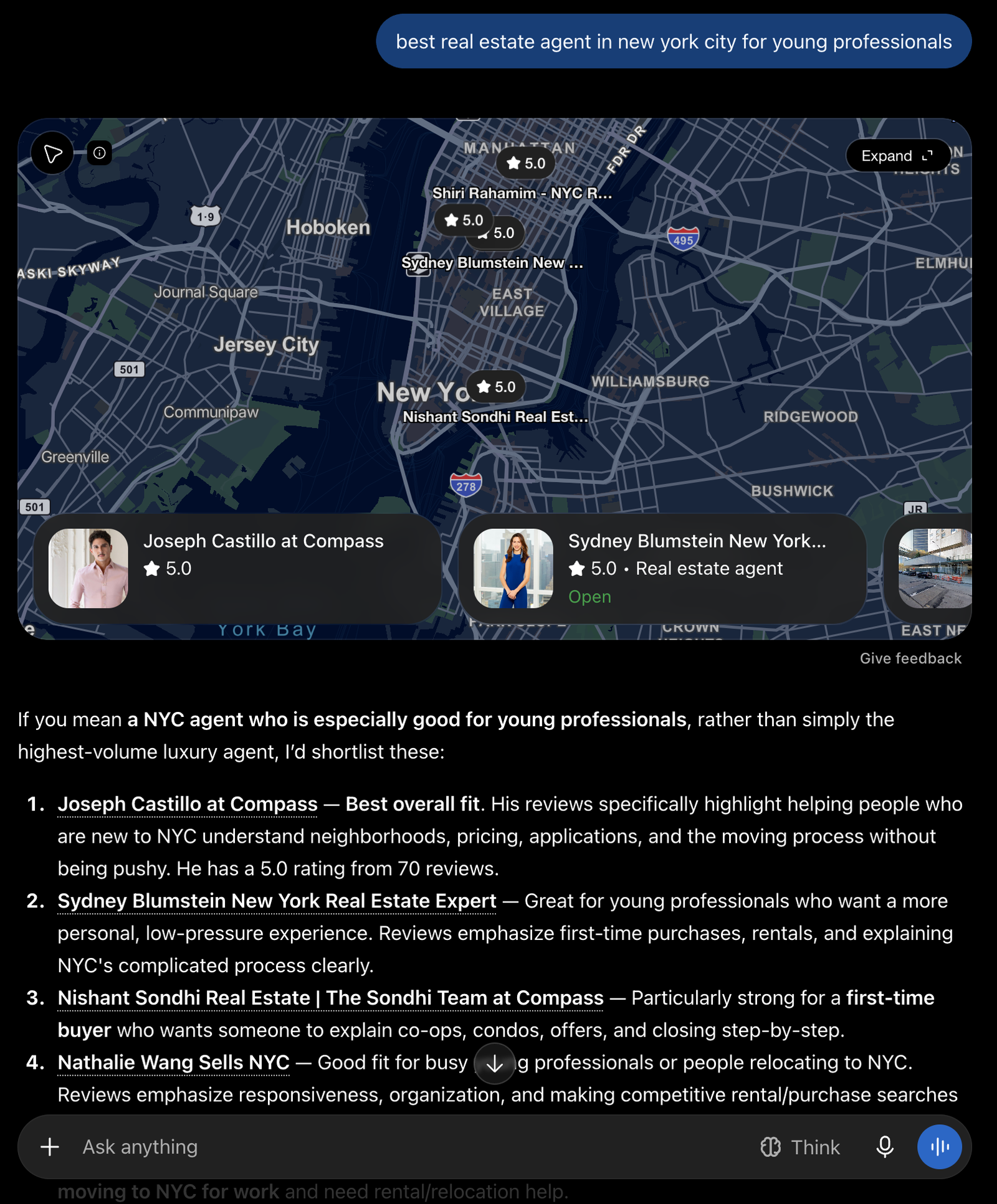
Buyers no longer type "realtor near me" and scan ten blue links.
They describe their situation to an assistant and get back three names, and if yours is not one of them, you never learn the search happened.
GEO is how you become one of the three.
Here's what we'll cover:
What generative engine optimization actually is, and how it differs from SEO and AEO
Why the measured gains favour challengers over market leaders
The four gates between your page and a buyer
Which assistants your market is already using
A step-by-step GEO checklist for real estate teams
Why good SEO is good GEO
How to use AI prompts to audit your site, content and competitors
Which tools can measure GEO visibility
How to measure whether any of it worked
What is generative engine optimization?
Generative engine optimization is the practice of structuring your content so large language models retrieve it, quote it, and attribute it when answering a question.
The output you are competing for is a sentence in an answer, not a position on a results page.
Three acronyms get used interchangeably, and they are not the same thing.
Term
What it optimizes for
What "winning" looks like
SEO
Ranked links on a results page
Position 1 to 3 for a query
AEO
Direct answers and featured snippets
Your text is the answer box
GEO
Synthesized AI answers with citations
The model names you as a source
The practical difference is attribution. A snippet borrows your sentence; a generative engine rewrites it and decides whether to say where it came from.
GEO rewards the challenger, not the market leader
“
The "40% visibility lift" quoted in every GEO article is an average that hides the interesting part.
When the researchers broke the results down by the page's original Google rank, adding source citations lifted a fifth-ranked page by 115.1% while cutting the top-ranked page's visibility by 30.3%.
Read that as a strategy note rather than a curiosity.
If your brokerage sits fourth or fifth for "best real estate agent in [your city]", generative engines are the cheapest share you will ever buy, because they weigh what your page says rather than how many domains link to it.
“
If you are already the market leader, the same edits can dilute you.
Your defensive move is different: publish the specific, quotable facts about your market that a model has no other source for, so the answer cannot be assembled without you.
The four gates between your page and a buyer
An AI answer is a pipeline, not a ranking, and most GEO advice only touches the middle of it.
A 2026 review of the field found that topical relevance and a source's position in the model's context are the most reproducible levers, and that a factorial experiment across six models and 252,000 trials identified relevance and position as the primary determinants of the first citation.
A perfectly formatted page that never gets retrieved contributes nothing, so classic discoverability work still comes first and technical SEO for real estate sites is the floor GEO stands on.
Where your market is already asking
“
Agents have adopted AI faster than they have adopted being found by it.
NAR's 2025 survey put AI or generative AI use at 41% of members, with ChatGPT named by 58% of AI users, Gemini by 20%, and Copilot by 15%, and 46% of agents reporting they use AI-generated content such as listing descriptions.
But here is the gap.
In the same survey, agents named social media, CRM, and their local MLS as the technologies producing the most quality leads, instead of an LLM.
The profession has treated AI as a production tool and not as a distribution channel…. Yet
A generative engine optimization checklist for real estate teams
1. Fix retrieval before you fix phrasing
Confirm your key pages are crawlable, indexed, fast, and free of client-side rendering that hides text.
Assistants that browse pull from a live fetch, so anything a crawler cannot read does not exist to them.
2. Publish one page per specific question
Models retrieve at the passage level, so a page that answers a single question outperforms a page that covers a topic broadly.
Lead each page with a self-contained paragraph that answers the title question without needing the rest of the page.
That paragraph is the unit a model lifts.
4. Add numbers, dates, and named sources
The three edits that measurably improved visibility in the original study were adding statistics, adding quotations, and citing sources.
In real estate that means median days on market with the month it was measured, not "homes sell fast here".
5. Mark up what you can prove
Schema does not force a citation, but it removes ambiguity about who you are and what you sell.
Getting real estate schema markup right on agent, listing, and FAQ pages is a one-time job with a long tail.
6. Keep your entity consistent everywhere
Name, licence, brokerage, service area, and phone number should match across your site, your profiles, and your Google Business Profile.
Models assemble an entity from scattered mentions, and contradictions cost you the mention. This is the same discipline that drives local SEO for real estate.
7. Cover the long questions, not the head terms
Conversational queries are longer than typed ones, so target the phrasing a buyer would speak rather than the two-word head terms you fight over in the SERP.
Use this prompt to audit where you stand today. Run it in each assistant, in a fresh session, several times, because answers vary run to run.
8. Build strong internal links for discovery
Link related neighbourhood pages, market reports, service pages, guides and question-based articles together using descriptive anchor text.
Secondly, build topic clusters around the questions buyers and sellers actually ask.
This helps search engines and AI systems discover related content and understand how your pages, topics and business entity connect.
7 Prompts To Help You Audit Your Website For GEO Discoverability
Use these prompts with ChatGPT, Gemini or another AI assistant to evaluate your website, content, competitors and off-site reputation.
Prompt 1: AI visibility audit
Plain text
Act as a buyer relocating to [CITY] with a budget of [BUDGET].
1. Recommend three real estate agents or teams and say why.
2. For each, list the sources you used.
3. Now tell me what you know about [YOUR TEAM NAME] in [CITY],
   and name the pages that information came from.
4. What would make you more confident recommending them?
5. What competing agents or teams appear to have stronger online
   evidence or authority than [YOUR TEAM NAME], and why?
Prompt 2: Website GEO audit
Give the assistant your website URL and ask:
Plain text
Audit [WEBSITE URL] for generative engine visibility.

Evaluate:
1. How clearly can you identify the company, people, services,
   locations and areas of expertise?
2. Which pages contain information that could be directly cited
   in an AI-generated answer?
3. Which important buyer questions are missing or poorly answered?
4. Are the answers specific, factual, current and supported by sources?
5. Are there contradictions in the company's name, services,
   locations, credentials or other entity information?
6. Which pages should be improved first to increase the likelihood
   of being cited by ChatGPT, Gemini, Perplexity and Google AI results?
7. Give me the 10 highest-impact content or technical changes,
   ranked by priority.
Prompt 3: Content citation audit
Plain text
Review this page as if you were deciding whether to cite it in an
AI-generated answer.

[PASTE PAGE URL OR CONTENT]

Score it from 1-10 for:
- topical relevance
- factual specificity
- original information
- source quality
- freshness
- answer clarity
- extractable/citable passages
- entity clarity
- depth of coverage

Then identify the five passages most likely to be cited and the
five changes most likely to improve citation potential.
Prompt 4: Buyer-question gap analysis
Plain text
For a buyer researching [TOPIC] in [CITY], generate the 25 questions
they are most likely to ask an AI assistant.

For each question:
1. Tell me what a strong answer should contain.
2. Identify whether [WEBSITE URL] currently answers it.
3. If it does, give the relevant page.
4. If it does not, recommend the page or content section we should create.
5. Prioritize the questions by likely business value.
Prompt 5: Competitor GEO comparison
Plain text
Compare [YOUR WEBSITE] with these competitors:
[COMPETITOR 1]
[COMPETITOR 2]
[COMPETITOR 3]

Evaluate which company has the strongest evidence for being
recommended by an AI assistant for [TARGET QUERY].

Compare:
- topical coverage
- local expertise
- original data
- citations and references
- entity consistency
- author expertise
- content freshness
- third-party mentions
- answerable buyer questions

Explain what the strongest competitor is doing that we are not.
Prompt 6: Test whether your content is actually quotable
Plain text
Read [URL].

Imagine you are answering:
"[BUYER QUESTION]"

Would you cite this page? If yes, identify the exact information
you would use and explain why. If no, explain what information is
missing, unclear, unsupported or too generic to cite.

Rewrite the weakest section so it provides a concise, factual answer
that could stand on its own when extracted from the page.
Prompt 7: Third-party reputation audit
Plain text
Evaluate the online reputation of [BUSINESS] across third-party websites, directories, review platforms, local profiles and industry publications. Identify which sources an AI assistant could use to verify the business, where information is inconsistent or incomplete, which profiles have weak or outdated information and where stronger reviews, citations or mentions could improve authority.
Good SEO is good GEO
The biggest mistake in the GEO conversation is treating it as a replacement for SEO.
It is not.
Good SEO is good GEO.
An AI assistant still needs to discover information, determine whether it is relevant, understand what entity it belongs to, assess whether it is credible and decide whether it is useful enough to include in an answer.
That means the fundamentals still matter:
Crawlable, indexable pages
Clear site architecture
Strong internal linking
Search intent alignment
Topical depth
Author and business expertise
Original research and data
High-quality external references
Consistent business and location information
Fresh, accurate content
Structured data where it adds clarity
GEO changes the output you are optimising for, not the fundamentals underneath it.
This is the more useful way to think about the relationship:
SEO
GEO
Helps search engines discover and rank your content
Helps generative systems discover and use your content
Optimises primarily for pages and queries
Optimises increasingly for passages, entities and answers
Measures rankings, clicks and organic traffic
Measures mentions, citations and AI referral traffic
Competes for visibility in search results
Competes for inclusion in generated answers
The new SEO question
For years, the question was:
“
How do we rank for this keyword?
The better question now is:
“
If a buyer asks this question, have we published the best answer on the internet, and is our business clearly connected to it?
That shift changes content strategy.
Instead of producing pages because a keyword tool says there is search volume, teams should identify the questions leads actually ask, determine what evidence a trustworthy answer requires and publish the most useful version of that answer.
Tools for Measuring GEO Visibility
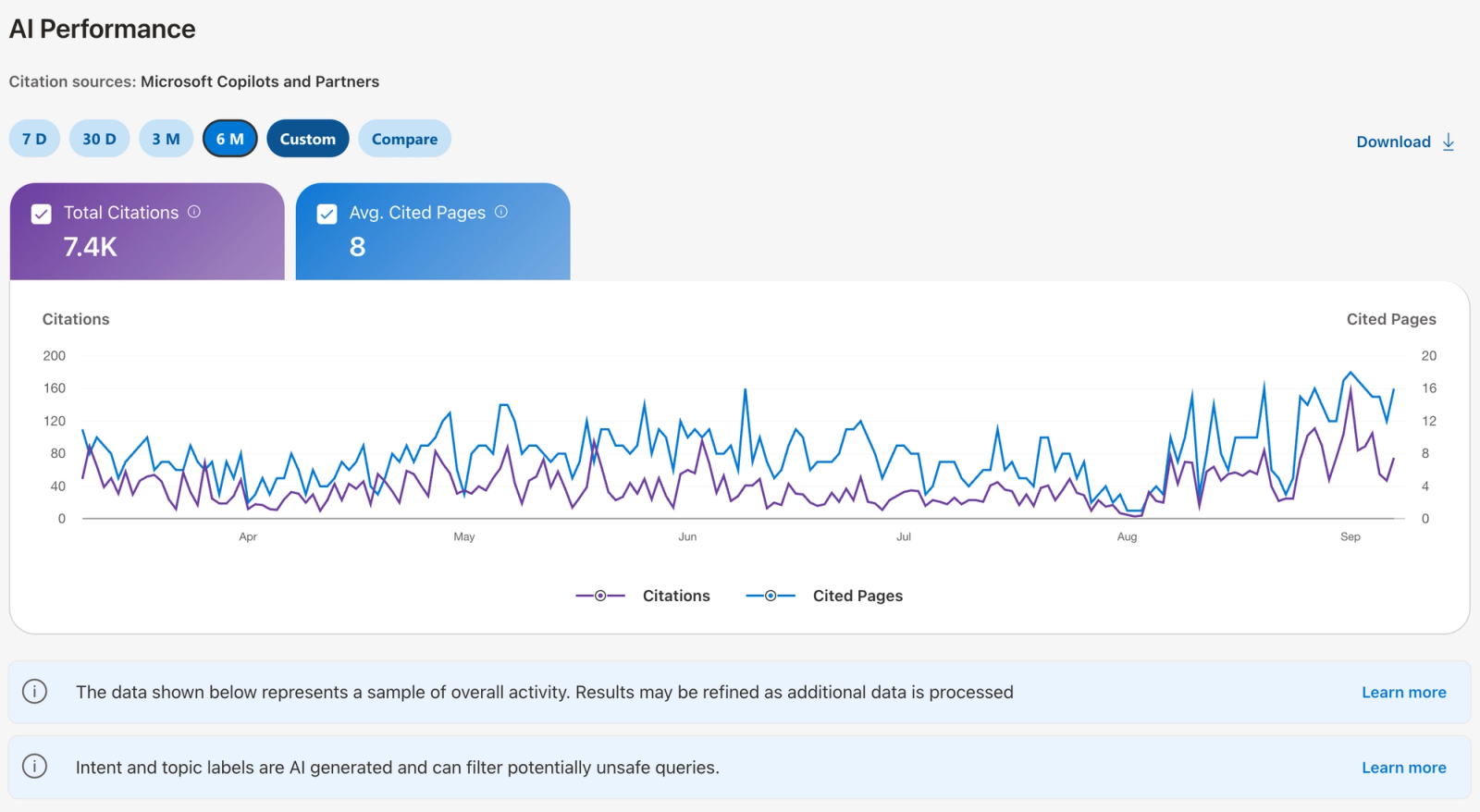
Bing Webmaster Tools (Free)
Bing Webmaster Tools provides search performance and indexing data from Bing that can support broader GEO analysis.
Profound (Paid)
Profound is built for tracking brand visibility in generative search and AI answers.
It can help monitor mentions, citations, competitors and changes in AI visibility over time.
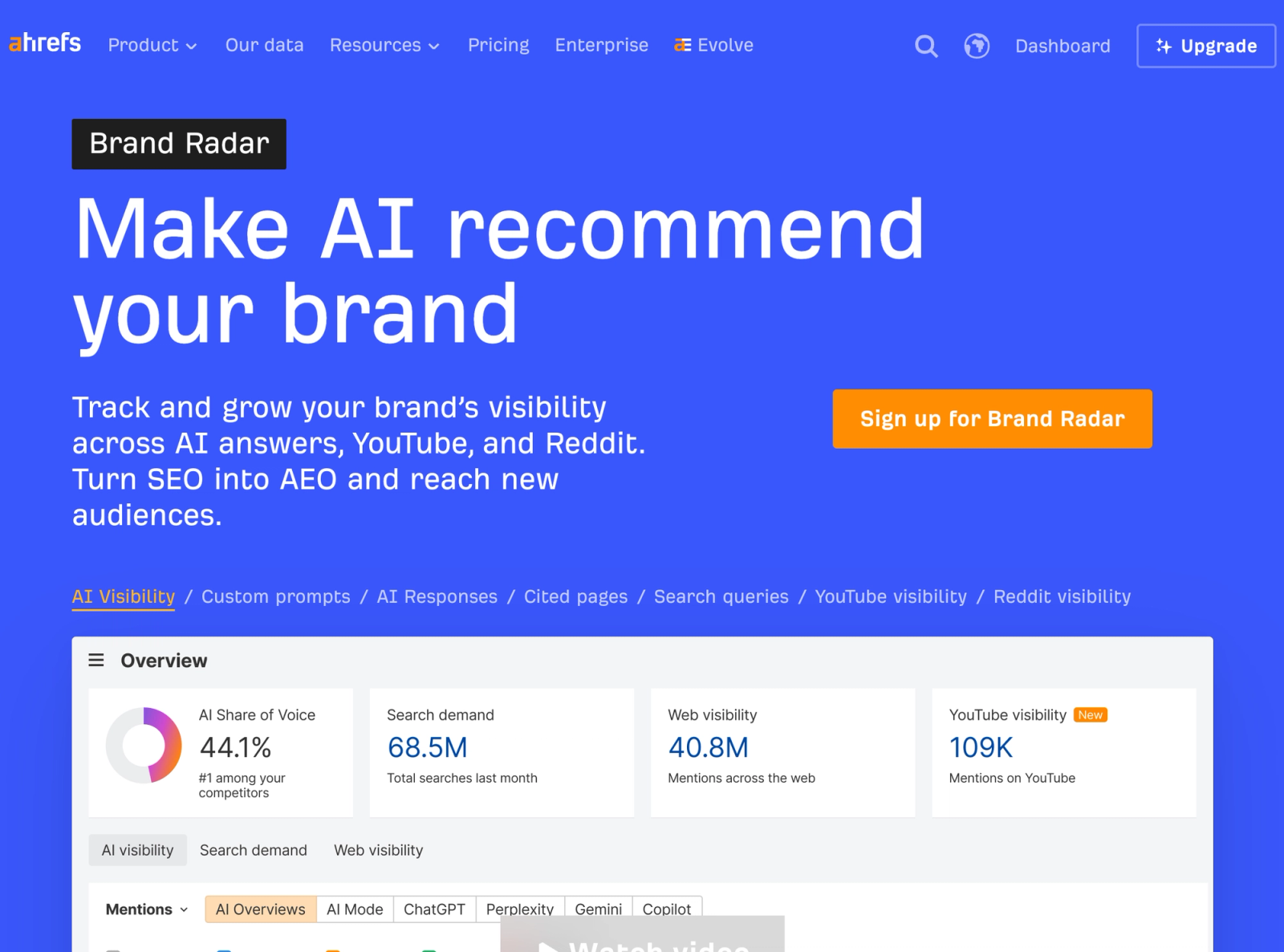
Ahrefs Brand Radar (Paid)
Ahrefs Brand Radar helps track how brands and websites appear across AI search experiences.
It can be used to identify prompts that mention your business, competitors appearing alongside you and sources being cited.
How to Measure It
Metric
What it tells you
Mention rate
How often the business appears in an answer
Citation rate
How often your website or content is cited
Citation position
How prominently your source appears
Competitor visibility
Which businesses are winning the same questions
Cited page
Which pages are earning AI visibility
AI referral traffic
Whether AI visibility is producing visits
Conversion rate
Whether those visits produce business
The Bottom Line
Generative engine optimization for real estate is not a reason to abandon SEO.
“
Good SEO is good GEO.
The strongest strategy is to build a technically sound, authoritative website that answers the questions buyers actually ask with specific, sourced and quotable information.
Then measure whether those answers are being discovered, mentioned and cited across the generative engines your market uses.
Ready to see what happens after the an AI chatbot sends them your way?
Book a demo and watch a live conversation get qualified.
Related articles
More in SEO & Marketing
Keep reading in the same category to go deeper on the topics that matter to your team.
Answer engine optimization explained for real estate: how AI answers pick their sources, what to publish, what to measure, and the fair housing line to stay behind.
How to create a high-converting MLS location page: the SEO structure that ranks it, the local content that earns trust, and the features that capture leads.
About Madison
The AI assistant built for real estate lead gen
Madison is Realty AI's conversational assistant for real estate websites. It engages visitors instantly, qualifies buyers, sellers, and renters through natural dialogue, routes summaries to your CRM, and keeps your team focused on closing.
5.0 average from 2,500 customer reviews
“We captured 3 new transactions worth over $3.3 million in just a few months using Realty AI.”
Sarah Logue
Broker & Owner, Top 0.1%
“Within our first week of using Realty AI, I had an engaged seller ready on the phone. This has never happened before in 4 years.”
Mark Jensen
Owner & Broker of Record
“It feels like having a personal assistant on my website 24/7, sending me instant notifications so I never miss a potential client.”